Top image: illustration, Foundation Repair Baton Rouge (AI-generated, not a photo of a real house).
FEMA now lets you buy a federal flood insurance policy entirely online. My take: if your Baton Rouge home has no flood policy, buy one this week, while the ground is cracked dry. The drought is exactly why it feels pointless, and exactly why the timing works.
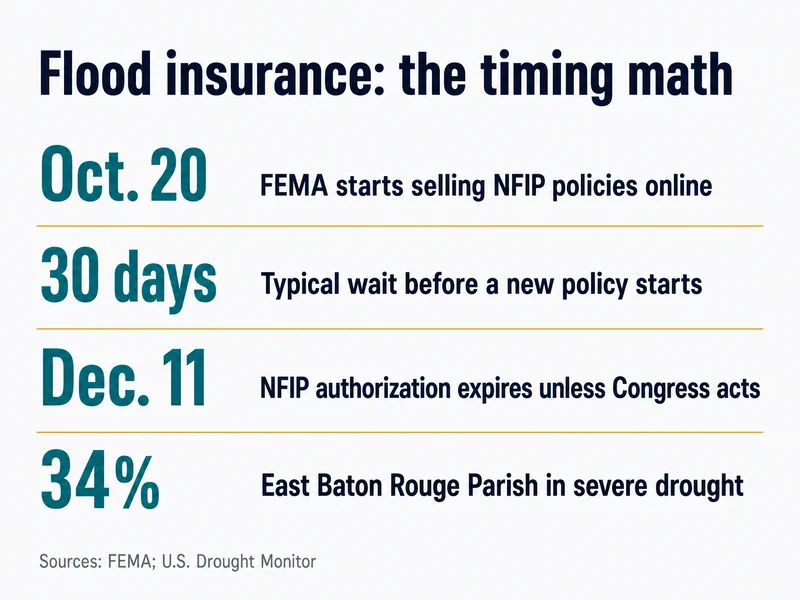
FEMA announced on October 20 that people in about 22,700 participating communities can get a quote and buy a National Flood Insurance Program (NFIP) policy at FloodSmart.gov. Administrator Cameron Hamilton said it lets people “get a quote and buy a flood insurance policy in a matter of minutes.” You can still send the quote to an agent instead.
WBRZ reports that Louisiana has about 393,000 NFIP policyholders and over $112 billion in coverage.
Why the dry weeks are the time to buy
Two dates matter more than the website. FEMA says there is typically a 30-day waiting period before a new NFIP policy takes effect. And Congress must reauthorize the NFIP by December 11, 2026. If it lapses, FEMA says it would “stop selling and renewing policies.” Buy today and coverage starts in late November, before that deadline.
Meanwhile, it hasn’t rained here since September 22, The Advocate reported on October 24. The latest U.S. Drought Monitor county data puts all of East Baton Rouge Parish in moderate drought or worse, and 34% in severe drought, up from 26% two weeks earlier. The parish went under a burn ban on October 23.
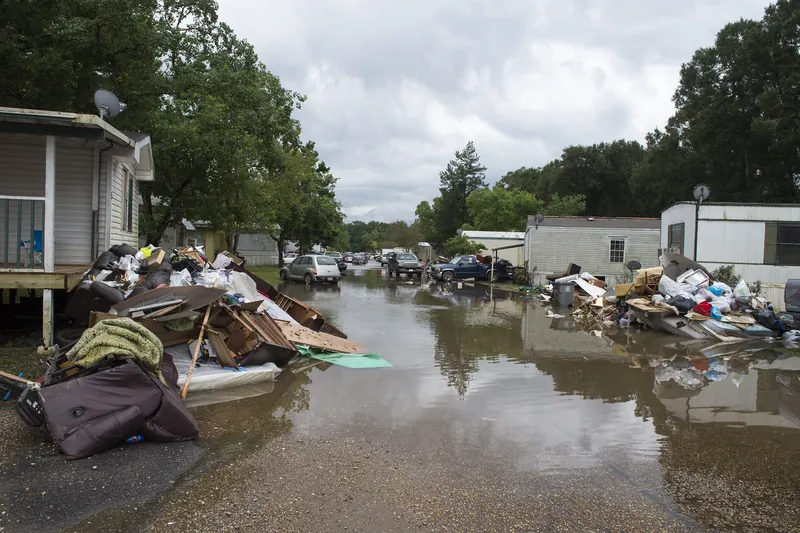
Nobody shops for flood coverage in a drought. That’s the mistake. In August 2016, Baton Rouge got over 19 inches of rain and about 40,000 homes were damaged, per NOAA. As AIR Worldwide’s Hemant Chowdhary told Insurance Journal then, “many of the areas that flooded were outside the 100-year floodplain.”

The fair objection: “My house didn’t flood in 2016”
Some owners skip it on purpose. On a 2023 TigerDroppings thread, a Baton Rouge Zone X owner said their rate was $365 a year in 2012 and about $500 by 2021. They said their newer house sits “much higher compared to 2016 flood levels,” so they don’t carry flood.
That’s a reasoned call, not a careless one. Height really does change risk: FEMA’s Risk Rating 2.0 guide says buildings with a higher first floor have lower flood risk. But it should be a measured decision, not a memory of one storm.
My take: what a Baton Rouge homeowner should do this week
- Get the free quote. The tool asks for your foundation type, construction and elevation, per Insurance Journal. Know if you’re on a slab or pier and beam before you start.
- Know what it covers on the foundation side. FloodSmart lists “foundation walls, anchorage systems and staircases” under building coverage, up to $250,000. But settlement after a flood is usually excluded. Here’s what flood insurance pays for on a foundation.
- Don’t confuse drought cracks with flood risk. Cracks from shrinking clay are a separate problem. Water the slab evenly and date your cracks now.
- If you’re flood-prone, look at height. For repeat flooding, house raising (see what raising costs in Louisiana) is the long-term fix. After substantial flood damage, an NFIP policy’s Increased Cost of Compliance can pay up to $30,000 toward it. Before you hire anyone to lift the house, check their license and the new $500,000 insurance minimum.
Livingston Parish owners should also follow the Comite Diversion Canal, since FEMA map changes tied to it could shift premiums after 2027.
WAFB’s forecast gives Halloween weekend only about a 30% rain chance. The drought will end eventually. Thirty days from now, you’ll be glad the policy was already running.
Worried about cracks now, or what a flood could do to your slab? Book a free evaluation with laser-measured readings, and a written per-piling price if you need one.