Key takeaways
- Hairline cracks in a home’s first year are usually concrete curing shrinkage, not structural settlement.
- Baton Rouge’s driest stretch runs through fall — normally November, per NWS climate data — which is when a new slab’s first real shrinkage often shows up.
- Fast-growing suburbs like Ascension and Livingston Parish build heavily on filled and re-graded clay lots, which settle unevenly if compaction wasn’t uniform.
- A crack that’s offset, growing, or paired with sticking doors is worth a free evaluation — even in a brand-new house.
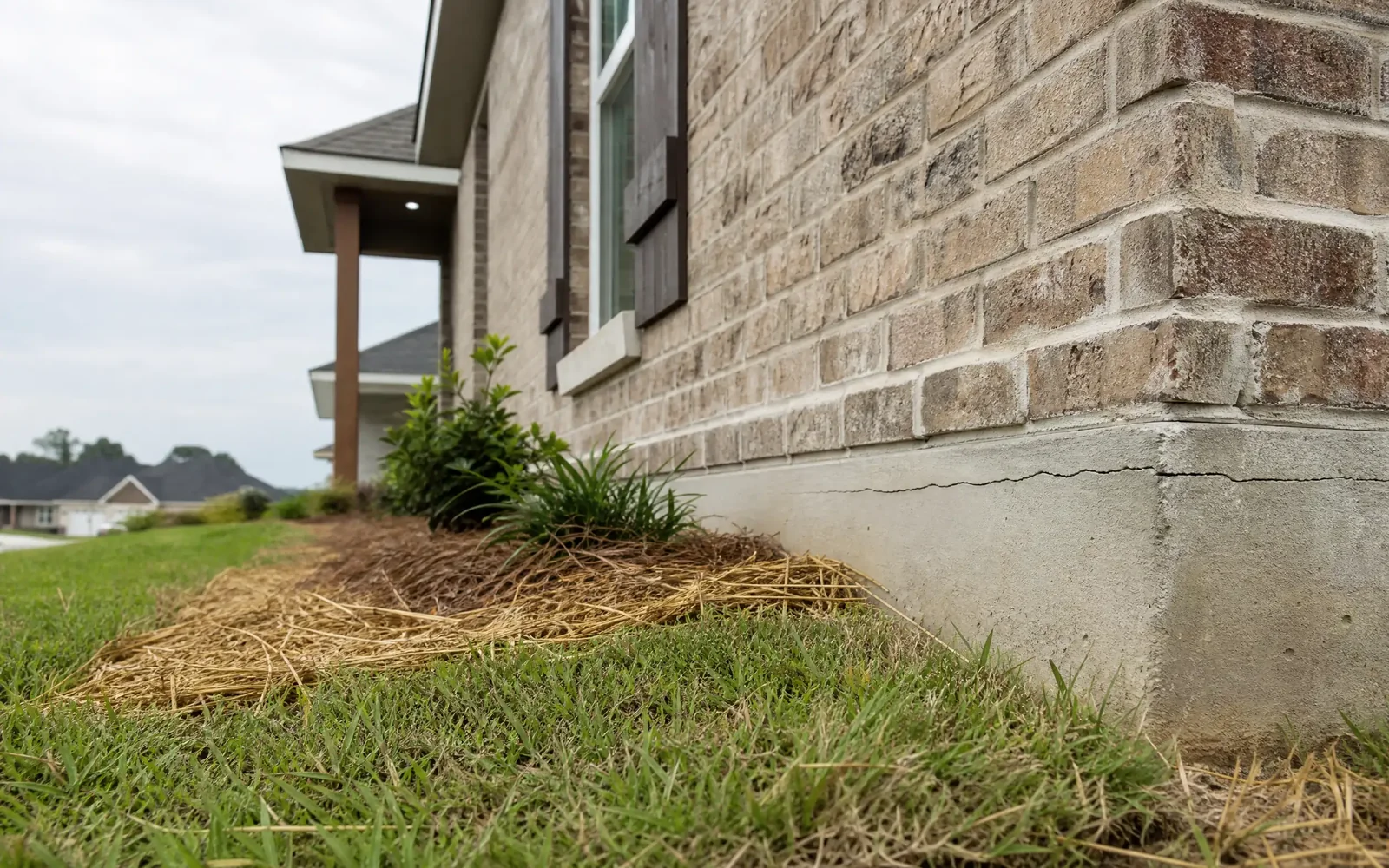
Foundation Repair Baton Rouge fields calls every fall about new construction foundation cracks — homeowners who moved into a new build in Gonzales, Prairieville, Denham Springs or Zachary a year or two ago and are now looking at a crack that wasn’t there at closing. It’s unsettling to see in a house that’s supposed to be new. Most of the time it’s ordinary. Here’s how to tell the difference.
Why Do Brand-New Homes in Baton Rouge Get Foundation Cracks?
Two different things cause cracking in a new slab, and they look similar but mean different things.
Curing shrinkage happens as concrete loses water while it hardens over its first year. It produces thin, hairline cracks — often in a slab’s middle third, not at corners — that stop growing once the concrete is fully cured. This is normal and expected; builders sometimes even saw “control joints” into a fresh slab specifically to direct shrinkage cracking somewhere harmless.
Differential settlement is different. It happens when the ground under part of the slab compacts or dries unevenly, so one section drops relative to the rest. That’s the crack that keeps growing, runs diagonally from a door or window corner, or shows up alongside a door that won’t latch.
Why New Construction on Baton Rouge Clay Is Especially Prone
Louisiana sits on some of the country’s most expansive clay, and Louisiana researchers have quantified just how much that costs: a 2021 risk study by LSU civil engineering researchers, published in Frontiers in Built Environment, put Louisiana’s statewide expansive-soil property losses at roughly $66 million a year, projected to grow toward $92 million by 2050 as building continues in higher-risk parishes. New construction adds a second variable on top of the clay itself: house pads are graded, sometimes filled, and compacted before the slab is poured (that pad is one of the trade-offs in pier and beam vs slab foundations). If that fill isn’t compacted evenly across the whole pad, the slab can settle unevenly as the site adjusts over its first few wet-dry cycles — which is exactly what’s happening right now heading into autumn.
Fall Is When It Tends to Show Up First
Baton Rouge’s rainfall is not evenly spread across the year. Per the National Weather Service’s 30-year climate normals for the Baton Rouge/New Orleans forecast area, November is normally the driest month at 3.90 inches, with September and October not far behind at 4.42 and 4.84 inches, against a wet-season peak of 6.36 inches in January. For a slab poured within the last year or two, that first real dry stretch pulls moisture out of the clay at the edges for the first time, and any unevenness in the pad’s compaction tends to reveal itself right about now — which is why new-construction crack calls cluster in fall.
Is It Normal or Should You Get It Checked?
A quick gut check, whether the house is one year old or thirty:
- Hairline, stable, not at a corner: almost always shrinkage. Note the date and keep an eye on it. Our guide to the types of foundation cracks explains corner pops and the other patterns.
- Wider than about a quarter inch, or growing: worth a look. See our crack width guide for the full framework, and our guide on how to fix foundation cracks step by step for what to do once you know.
- Diagonal from a door or window corner, or paired with a door that’s started sticking: that’s a sign of differential settlement, not curing.
- Running in a line with cracks in the driveway or street: worth a closer look rather than an assumption either way.
What Louisiana’s New Home Warranty Act gives you
If a builder sold you the house, Louisiana law sets minimum warranties that can’t be waived. Under the New Home Warranty Act, R.S. 9:3144, the home must be free of defects for set periods after the “warranty commencement date”:
| Coverage | Period | What the statute says |
|---|---|---|
| General defects in materials or workmanship | 1 year | “One year following the warranty commencement date, the home will be free from any defect” |
| Plumbing, electrical, heating, cooling and ventilating systems | 2 years | Appliances, fixtures and equipment excluded |
| Major structural defects | 5 years | “Five years following the warranty commencement date, the home will be free from major structural defects” |
Source: Louisiana Legislature, R.S. 9:3144 (checked Nov. 5, 2026). The commencement date is generally the earlier of title transfer or first occupancy, so check your closing documents.
The deadlines are strict. Under R.S. 9:3145, you must give the builder written notice of the defect by registered or certified mail, within one year after you knew of it, before you repair it yourself or sue. Under R.S. 9:3144, the notice must also go out before the warranty period ends (plus 30 days). A crack you photographed in month 10 matters more than one you find in month 14. This is a summary of the statute, not legal advice; a Louisiana construction attorney can tell you how it applies to your house.
Which crack counts? Hairline shrinkage cracks rarely qualify as a “major structural defect.” Settlement that tilts floors or jams doors is a better candidate. That’s why a dated, laser-measured record helps, and why you should ask for an outside opinion before the window closes. Many builders’ own warranties add exclusions for soil movement, so read yours alongside the statute.
Get a Second Opinion, Free
If a crack in your new build doesn’t fit the “hairline and stable” description, it’s worth a laser-measured evaluation before you decide whether it’s a warranty issue or something to fix. Foundation Repair Baton Rouge offers a free evaluation with no obligation — contact us and we’ll take a look.
FAQ
Is it normal for a new-construction house to have foundation cracks?
Thin, stable hairline cracks in the first year are common and are usually concrete curing shrinkage, not a structural problem. Cracks that are wide, growing, offset, or paired with sticking doors are not typical and are worth an evaluation.
How long after construction do settlement cracks usually appear?
Curing shrinkage cracks can appear within the first year. Differential settlement cracks from uneven soil compaction often take longer to show up — commonly after the slab has been through at least one full wet season and one full dry season, which is why many new-construction calls come in the fall or two after closing.
Will my builder fix a foundation crack in a new home?
Louisiana’s New Home Warranty Act requires builders to warrant the home against defects for one year, and against major structural defects for five years. Notice must be in writing, by registered or certified mail. Whether a particular crack qualifies depends on its cause, so get an independent, dated evaluation, and check your own warranty for added exclusions.
Does a structural warranty cover foundation settlement from soil movement?
Often not — most structural warranties are written to cover defects in materials or construction, not the behavior of the native or fill soil under the house. That’s why an independent, laser-measured evaluation is useful: it documents what’s actually happening before any warranty claim or repair decision.