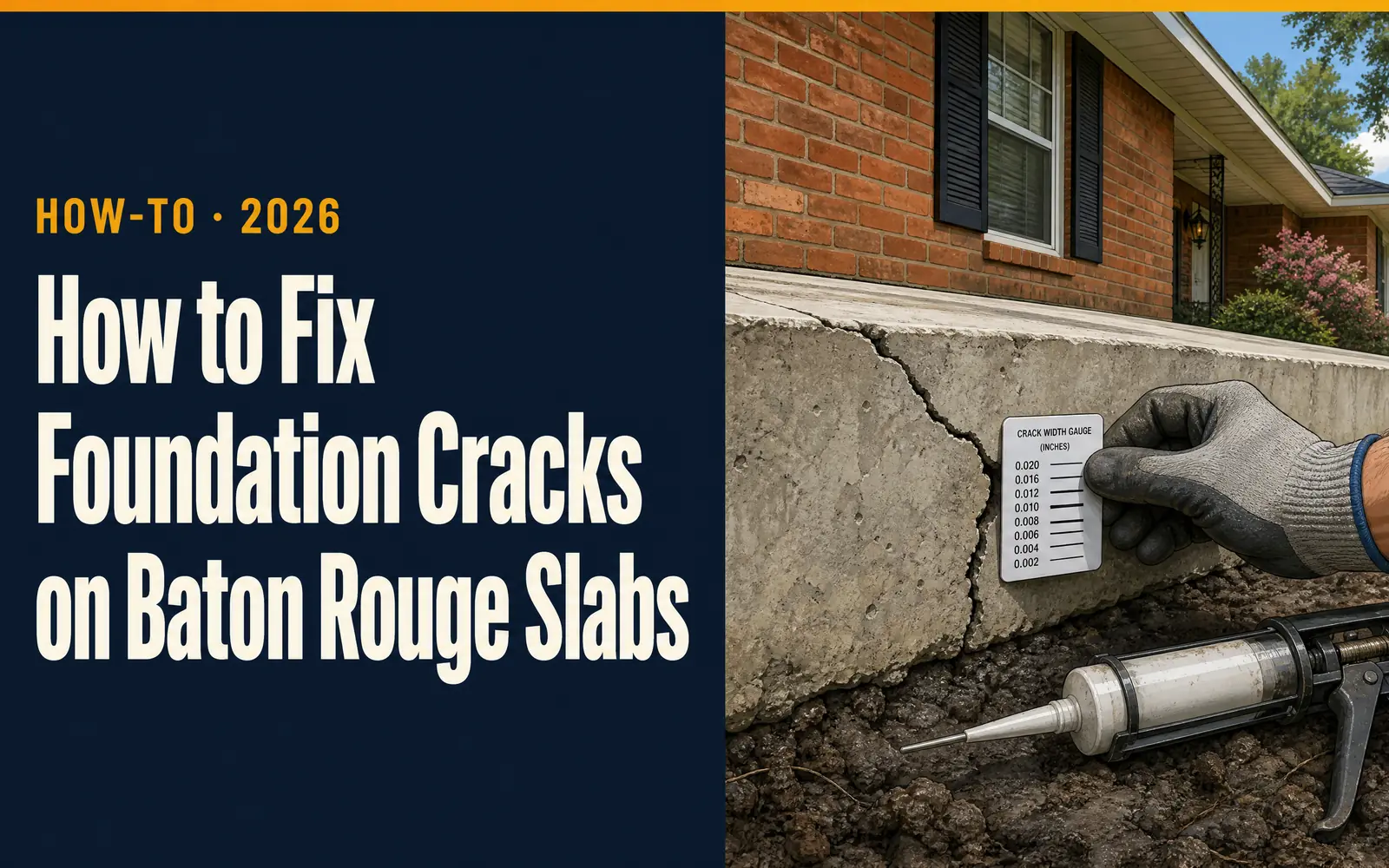
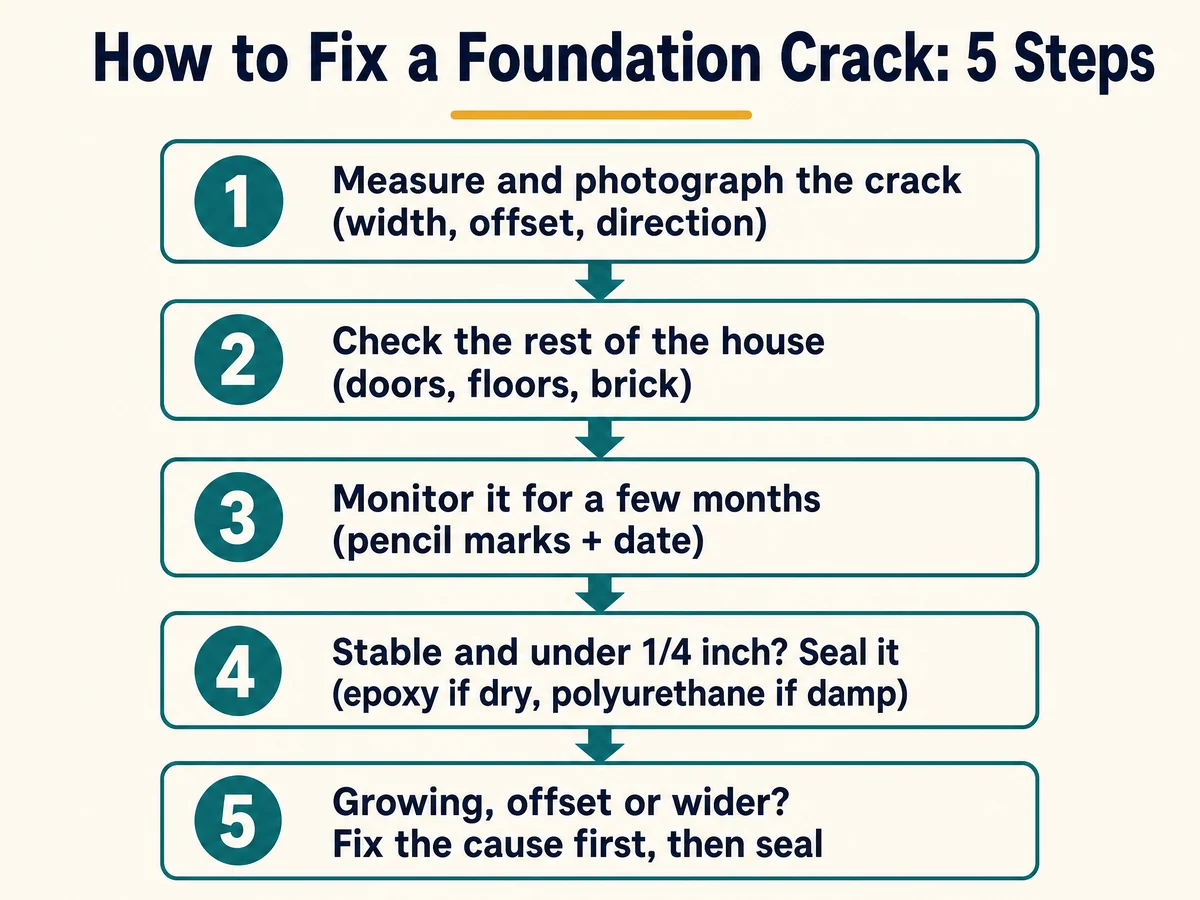
How to fix foundation cracks: measure the crack, check the rest of the house for movement, monitor it for a few months, then seal it only if it is stable and under about 1/4 inch. If it is growing, offset or wider, fix what is moving the slab first, then seal the crack.
Key Takeaways
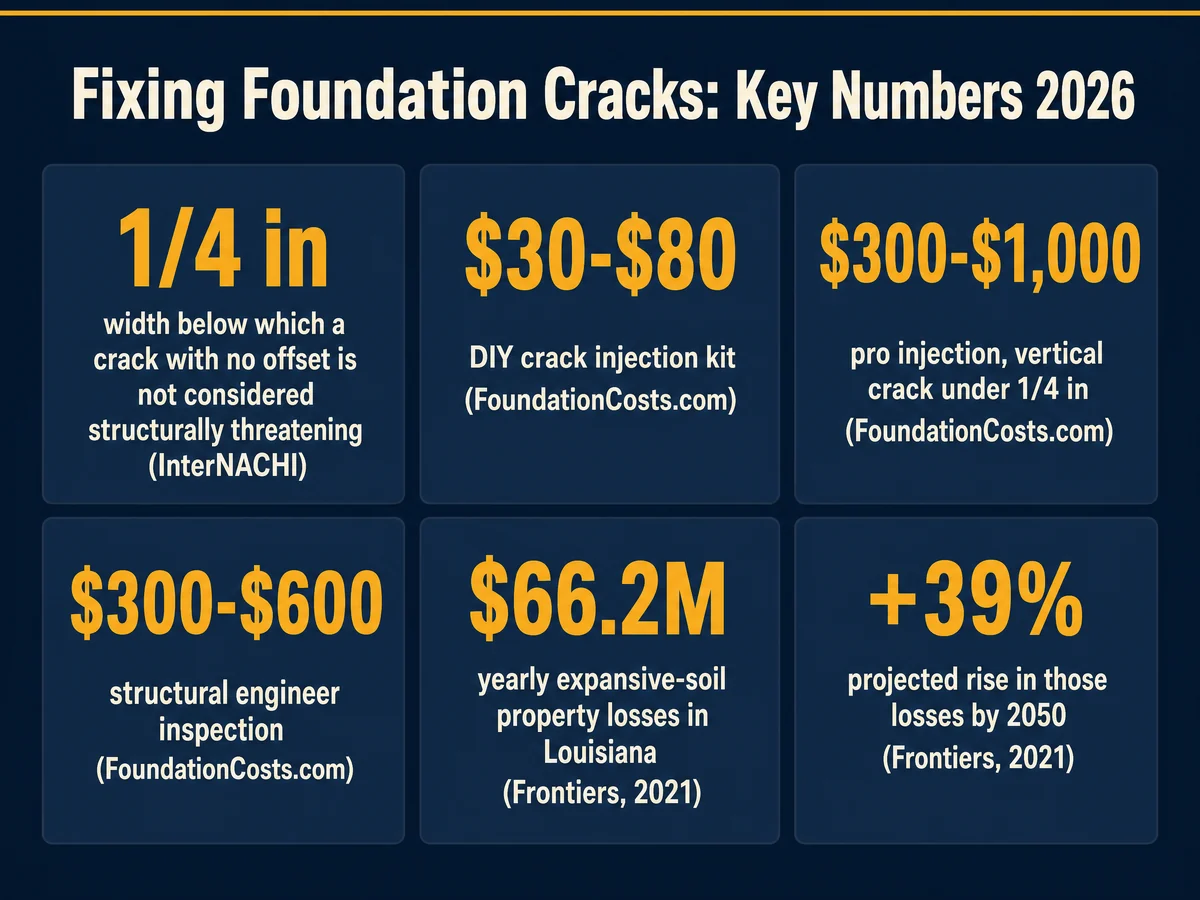
- Cracks under 1/4 inch with no significant vertical or horizontal displacement "are not regarded as being structurally threatening" — InterNACHI
- The American Concrete Institute's crack-repair guide treats finding the cause, and whether a crack is active or dormant, as the first step before any repair — ACI 224.1R-07
- A DIY injection kit costs about $30–$80; a professional injection of a vertical crack under 1/4 inch runs about $300–$1,000 — FoundationCosts.com, April 2026
- Epoxy bonds a dry, dormant crack; flexible polyurethane seals damp cracks and ones that still flex with the seasons
- Expansive clay costs Louisiana about $66.2 million a year in property losses, with Baton Rouge named first among the hardest-hit urban centers — Frontiers in Built Environment, 2021
- Never seal a crack you are still monitoring: it hides whether the slab is still moving
What does “fixing” a foundation crack actually mean?
Fixing a foundation crack means two different jobs, and most bad repairs come from doing only the second one. The first job is stopping whatever moved the concrete. The second is sealing the gap so water, insects and humidity can’t get in.
On a Baton Rouge slab, most cracks come from one of two things. Concrete shrinks as it cures, and the Portland Cement Association, quoted by InterNACHI, calls restraint to shrinkage “the most common cause of concrete cracking.” The other cause is the expansive clay under the house shrinking in dry spells and swelling when it’s wet, which bends the slab.
A shrinkage crack is finished moving, so sealing it is the whole repair. A crack from clay movement will keep opening and closing until the soil moisture or the support under the slab changes. Mason contractor Mark McCullough told This Old House that “sealing the crack alone won’t solve the issue if moisture and pressure aren’t addressed at the source.”
What do you need before you fix a foundation crack?
You need a few cheap tools for the diagnosis and, only if the crack turns out to be stable, a sealing product. Here’s the kit:
- A crack-width gauge card or a fine ruler. Plastic crack comparator cards read down to a few thousandths of an inch.
- A pencil, a phone camera and a coin or ruler for scale. These are your monitoring log.
- A 4-foot level, or a marble. Use it on floors near the crack to spot slope.
- For sealing only: a two-part epoxy or polyurethane crack injection kit, or a concrete-rated polyurethane sealant for surface cracks, plus a wire brush and a shop vac.
Wear gloves and eye protection when you work with epoxy. Follow the kit maker’s temperature and cure instructions, because cold slabs slow the cure.
Step 1: How do you measure and record a foundation crack?
Measure the crack’s width at its widest point, note its direction, and check whether one side sits higher than the other. Those three facts tell you most of what you need to know.
No gauge? The Foundation Performance Association’s homebuyers’ guide suggests estimating width with coins, a credit card or a tape measure, and noting whether the crack is wider at the top or the bottom. Hold the gauge card across the crack and write the reading on the concrete in pencil, with the date. Mark both ends of the crack with a short pencil tick and a date too. This Old House gives the same advice: “mark its ends with a pencil and date them, or take a photo to compare over time.”
Then run a fingertip across the crack. If one side is higher, that’s vertical offset. InterNACHI notes that cracks caused by soil settlement or heaving “typically exhibit vertical displacement of the concrete; concrete on one side of the crack will be higher than concrete on the other side” (InterNACHI). Offset means the ground moved, not just the concrete.
| What you measure | Usually means | What to do next |
|---|---|---|
| Hairline, under 1/16 in, no offset | Shrinkage or minor seasonal movement | Monitor, then seal if it stays the same |
| 1/16 to 1/4 in, no offset | Could be either; watch it | Monitor through a season before sealing |
| Over 1/4 in | More likely soil movement | Get it evaluated before sealing |
| Any width with offset | Settlement or heave | Fix the cause first |
| Any width that keeps growing | Active movement | Do not seal yet; get elevations taken |
Our crack width guide goes deeper on what each width and direction usually means, and our explainer on the types of foundation cracks shows what hairline, diagonal, horizontal and corner-pop cracks look like on a slab home.
Step 2: How do you check the rest of the house for foundation movement?
Check whether the crack is alone or part of a pattern. A single hairline crack in a garage slab means little. The same crack plus sticking doors and stair-step brick cracks on the same corner points to a slab that is moving.
Walk the house with the signs of foundation problems list in hand:
- Doors that stick or won’t latch, especially on one side of the house.
- Diagonal cracks running up from door and window corners.
- Stair-step cracks in brick veneer (see our brick crack repair page, and our explainer on what stair step cracks in brick mean).
- Floors that slope enough for a marble to roll, or tile cracks running in a line. The same FPA guide says a slope of more than about 1/4 inch over a 4-foot carpenter’s level may mean unacceptable movement and is worth a professional engineer’s look.
- A soil gap along the slab edge in dry weather, and downspouts dumping water at the slab.
If the signs cluster on one side, that’s the side where the clay is shrinking or swelling most. Our guide to house settling vs foundation problems explains how to tell normal settling from ongoing movement.
Step 3: How long should you monitor a foundation crack?
Monitor a foundation crack for at least a few months, and ideally across a wet-to-dry season change. Bob Vila’s crack repair guide says to “check the crack at least monthly for several months” before sealing a small crack.
In Baton Rouge, timing matters more than in most places. The clay is wettest after spring storms and driest in August and September, so a crack can open in late summer and partly close again by winter. A crack that only changes with the seasons is telling you the soil moisture swings; a crack that grows a little more each season is telling you the slab is losing support.
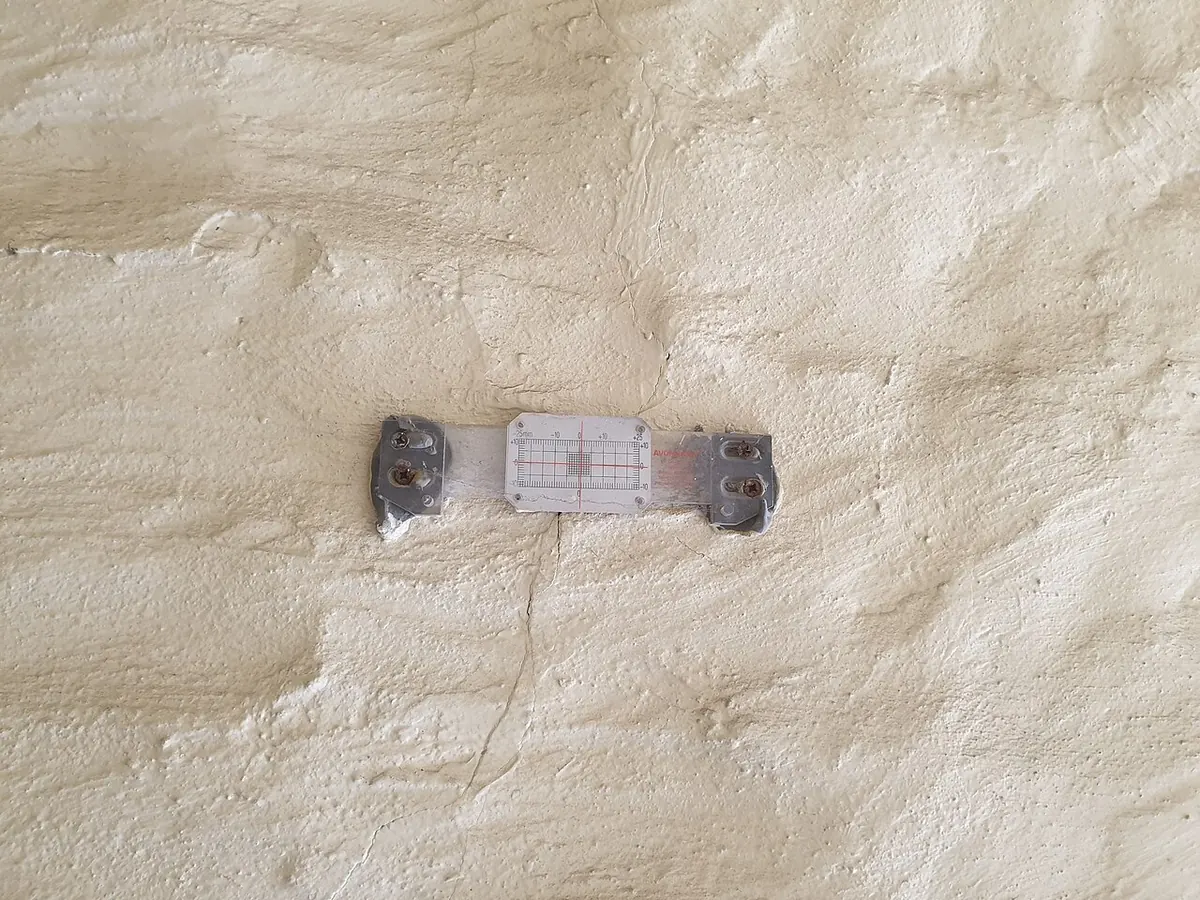
Keep it simple: once a month, measure at your pencil mark, photograph it next to a coin, and write the date. If the crack grows in width or length, stop here and get it evaluated. Tom Silva of This Old House puts it bluntly: “any crack that appears suddenly isn’t normal, and any crack that continues to grow in width or length isn’t normal” (This Old House).
Step 4: How do you seal a stable foundation crack?
Seal a stable foundation crack by cleaning it, then injecting or filling it with a product matched to its condition. Use epoxy for a dry, dormant crack and polyurethane for a damp one or one that still flexes a little.
The American Concrete Institute’s crack guide, ACI 224.1R-07, covers the main repair methods. It frames the choice of method around the cause of the crack and whether it is still moving, which is why steps 1 to 3 come first.
- Clean the crack. Wire-brush loose concrete and vacuum out dust. The crack should be dry for epoxy.
- Set the injection ports. DIY kits come with surface ports you glue along the crack, spaced a few inches apart. Don’t drill for ports on a post tension slab without locating the tendons first.
- Cap the surface. Spread the kit’s paste sealer over the crack between the ports so the resin can’t leak out.
- Inject from one end. Pump resin into the first port until it appears at the next one, plug it, and move along.
- Let it cure, then trim. Once cured, cut or grind off the ports and surface cap.
For slab cracks under flooring or cracks at a slab edge, a concrete-rated polyurethane sealant is often enough. Hydraulic cement and ordinary caulk are short-term patches; they tend to pop loose if the crack moves at all.
| Method | Best for | Main drawback | Typical cost |
|---|---|---|---|
| Epoxy injection | Dry, dormant cracks where you want a structural bond | Rigid; if the slab moves again it cracks beside the repair | Kit $30–$80; pro $300–$1,000 per crack |
| Polyurethane injection | Damp cracks and cracks with small seasonal movement | Seals, but does not add strength | Kit $30–$80; pro $300–$1,000 per crack (priced together with epoxy) |
| Polyurethane sealant (surface) | Hairline slab and slab-edge cracks | Surface seal only | Cheapest option; hardware-store product |
| Hydraulic cement | Emergency plugging of a wet crack | Often loosens as the crack moves | Cheap, short-term |
Cost ranges from FoundationCosts.com (April 2026), where it prices DIY kits at $30–$80 and professional injection of a vertical crack under 1/4 inch at $300–$1,000. Bob Vila puts the full range for crack repair at “less than $50 for a hairline crack to greater than $8,000 for a serious fix.”
Step 5: How do you fix foundation cracks that keep growing?
You fix a growing, offset or wide foundation crack by stopping the movement behind it first, then sealing the crack. On Baton Rouge clay that almost always means one of two repairs: controlling water around the slab, or supporting the slab on pilings.
Get elevations before you pay for anything. A laser elevation survey across every room shows whether the slab has a low corner and how much. That, plus your monitoring log, tells a contractor or an independent structural engineer what is actually moving. FoundationCosts.com puts an engineer’s assessment at about $300 to $600.
If the cause is water, fix the drainage: extend downspouts, correct grading that slopes toward the slab, and add a French drain where water sits (see how to install a French drain in clay). Our foundation drainage service covers this. Big trees near the slab are a common driver too; see how tree roots dry out Baton Rouge clay.
If a section of slab has settled, it needs support. In Baton Rouge that usually means pressed concrete pilings driven under the settled area, and the cracks get sealed after the slab is lifted or stabilized. Our foundation crack repair service follows that order: measure, test for movement, fix the cause, then seal. For the full sequence, see how to fix a settling foundation.
Dry summers make this worse. The 2026 dry spell is covered in our post on foundation cracks after drought, and newer homes have their own pattern, covered in new construction foundation cracks.
Why do foundation cracks come back in Baton Rouge?
Foundation cracks come back in Baton Rouge because the clay keeps moving after the crack is sealed. A 2021 study in Frontiers in Built Environment put Louisiana’s average yearly property loss from expansive soil at $66,231,136, projected to grow 39% to $91,753,149 by 2050. The authors name Baton Rouge first among the southern urban centers where losses concentrate.
A rigid epoxy repair on a slab that still flexes will hold, and the concrete will crack again next to it. That’s not a failed product. It’s the soil telling you the cause wasn’t fixed.
What have Louisiana homeowners found when they checked their cracks?
Real cases from the region show the same pattern: most cracks turn out to be minor, and the expensive mistakes come from guessing instead of measuring.
- Prairieville, 1/8-inch slab cracks under carpet. A homeowner in Ascension Parish posted on TigerDroppings (November 2024) after pulling up carpet and finding 1/8-inch cracks running nearly the length of two bedrooms, with no sticking doors or drywall cracks. Replies, including one from a poster with 20 years in the concrete industry, read them as shrinkage cracks and suggested watching the walls and sealing the cracks against termites and moisture. That is exactly the step 1-3-4 path in this guide.
- A Louisiana home where the “foundation” cracks came from the roof. Another TigerDroppings thread (January 2023) started with sheetrock cracks and worry about sales pitches; one reply mentioned a contractor proposal of $60,000 on a different house. The homeowner hired an independent structural engineer, who traced the cracks to a poorly braced roof. The slab had only caused cosmetic tile cracks, and no foundation repair was needed.
- Jackson, Mississippi, a corner slab repair on clay. A homeowner dealing with a sinking slab corner on Yazoo clay described being told (2025) to wait about six weeks after the outside repair before fixing interior cracks, and some existing cracks got worse after the lift. Sealing comes last for a reason.
Published cost guides back up how cheap the sealing part is compared with the cause. HomeAdvisor (updated June 2026) lists crack sealing at $250 to $800 and a structural engineer at $340 to $780, against an average of $5,174 for foundation repair overall.
Our take: what I’d do with a foundation crack in Baton Rouge
Opinion and analysis by Jonathan Dyer, based on the sources above.
Coming from structural concrete and steel repair work, my view is that a crack is a measurement, not a verdict. In industrial repair the rule is the one ACI puts first: find the cause and decide whether the crack is active or dormant before choosing a material. Houses are no different.
Here’s what I’d do. I’d log the crack for a full dry-to-wet cycle; in Baton Rouge that means from late summer into winter. If it doesn’t move and it’s under 1/4 inch with no offset, I’d inject it with epoxy if it’s dry or polyurethane if it’s damp, and move on. If it grows, or the doors and floors near it say the slab is moving, I’d get elevations before paying anyone to fill it, because a rigid filler on a moving slab just moves the crack a few inches over.
The Louisiana cases above are the reason. Measuring first saved one homeowner a foundation job they didn’t need, and the Prairieville cracks that looked alarming under the carpet were ordinary shrinkage. Measuring and waiting costs almost nothing. Guessing is what gets expensive.
What goes wrong when homeowners fix foundation cracks?
The most common mistakes are about timing and diagnosis, not technique:
- Sealing too early. A sealed crack can’t tell you whether it’s growing. Monitor first.
- Treating the crack as the problem. If doors stick and floors slope on that side, the crack is a symptom.
- Using rigid filler on a moving crack. Epoxy or mortar in a crack that still opens and closes will crack again beside the repair.
- Patching over a wet crack with epoxy. Epoxy needs a dry crack; use polyurethane where there’s moisture.
- Skipping the drainage. A downspout emptying at the slab edge will keep wetting and drying the clay under that corner.
Methodology. This guide is built from published sources, not from a customer project: InterNACHI's inspection guidance, the American Concrete Institute's ACI 224.1R-07 crack-repair report, This Old House and Bob Vila repair guides, 2026 cost data from FoundationCosts.com, and the 2021 LSU-led Louisiana expansive-soil study. Search demand was checked with DataForSEO in September 2026 ("how to fix foundation cracks": about 1,600 U.S. searches a month). Homeowner experiences are paraphrased from public posts and linked to their sources. No customer stories, quotes or jobs are invented. The illustrations are AI-generated and do not show real repairs.
Not sure if your crack is cosmetic?
Book a free evaluation: we take laser elevations in every room, map and measure every crack, and tell you in writing whether it just needs sealing. Request a free evaluation or try the foundation damage self-assessment first.