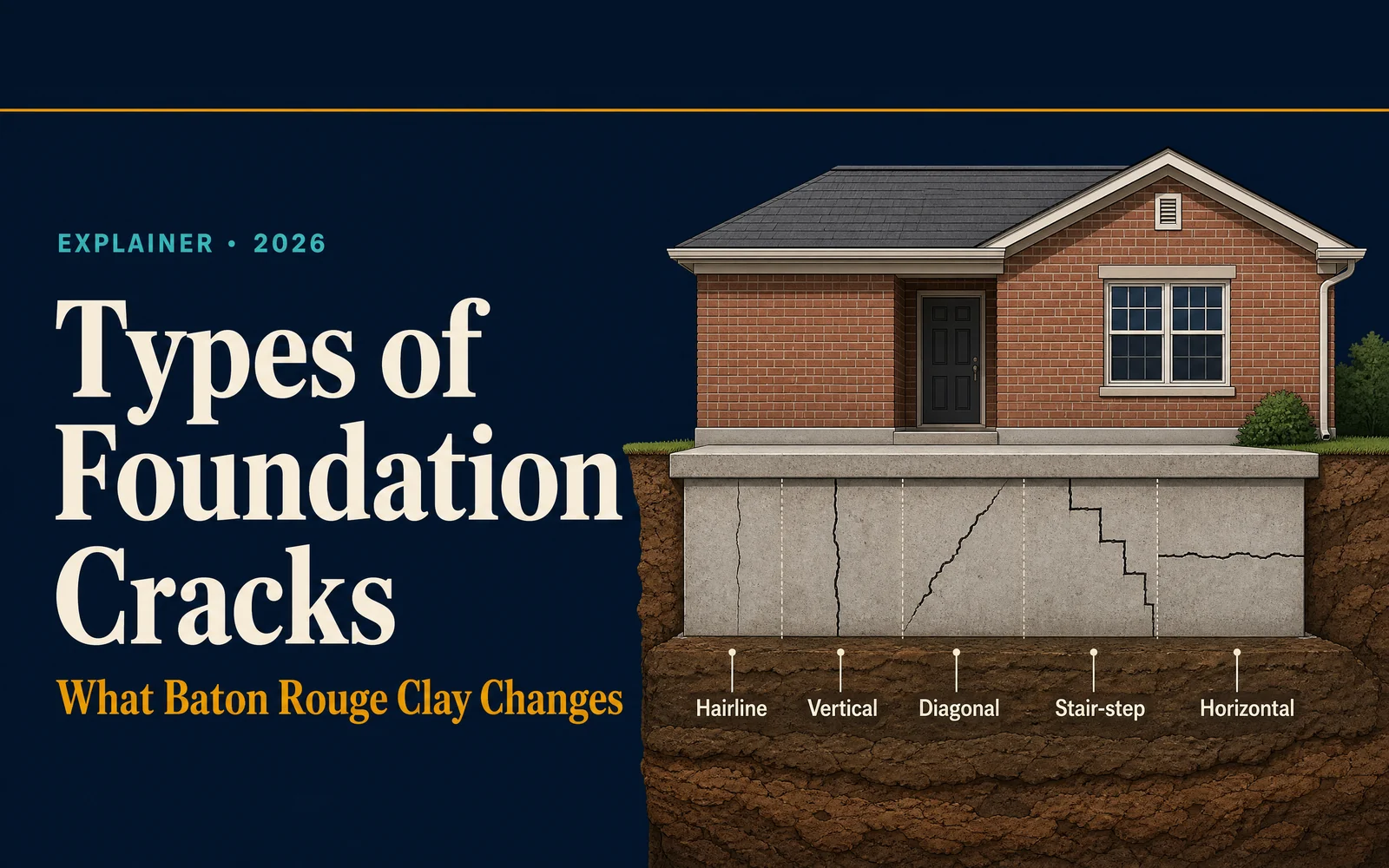
What are the types of foundation cracks? On a Baton Rouge slab home there are six: hairline shrinkage cracks, vertical cracks, diagonal cracks, stair-step brick cracks, horizontal cracks and corner pops. Most are cosmetic. The ones that matter taper, keep growing or have one side higher than the other.
Key Takeaways
- "The vast majority of cracks are 'cosmetic,' not 'structural'" and "There is no absolute universal standard for evaluating cracks" — Walt Keaveny, P.E., NAHB, 2018
- NAHB guidelines flag concrete floor slab cracks over 3/16 in, masonry cracks over 1/4 in and drywall cracks over 1/16 in — NAHB, 2018
- A slab crack of 1/8 in or less "is typically a normal shrinkage crack and not a cause for concern" — Steve Bliss, BuildingAdvisor
- Plastic shrinkage cracks run roughly parallel, 1 to 3 ft apart, and "rarely impair the strength or durability" of a slab — NRMCA, CIP 5
- On the Baton Rouge faults, brick cracks usually slope northward at about 45° as the south side of a building drops — Louisiana Geological Survey, 1981
- Sealing a minor crack typically costs $250 to $800 — HomeAdvisor, June 2026
What are the main types of foundation cracks?
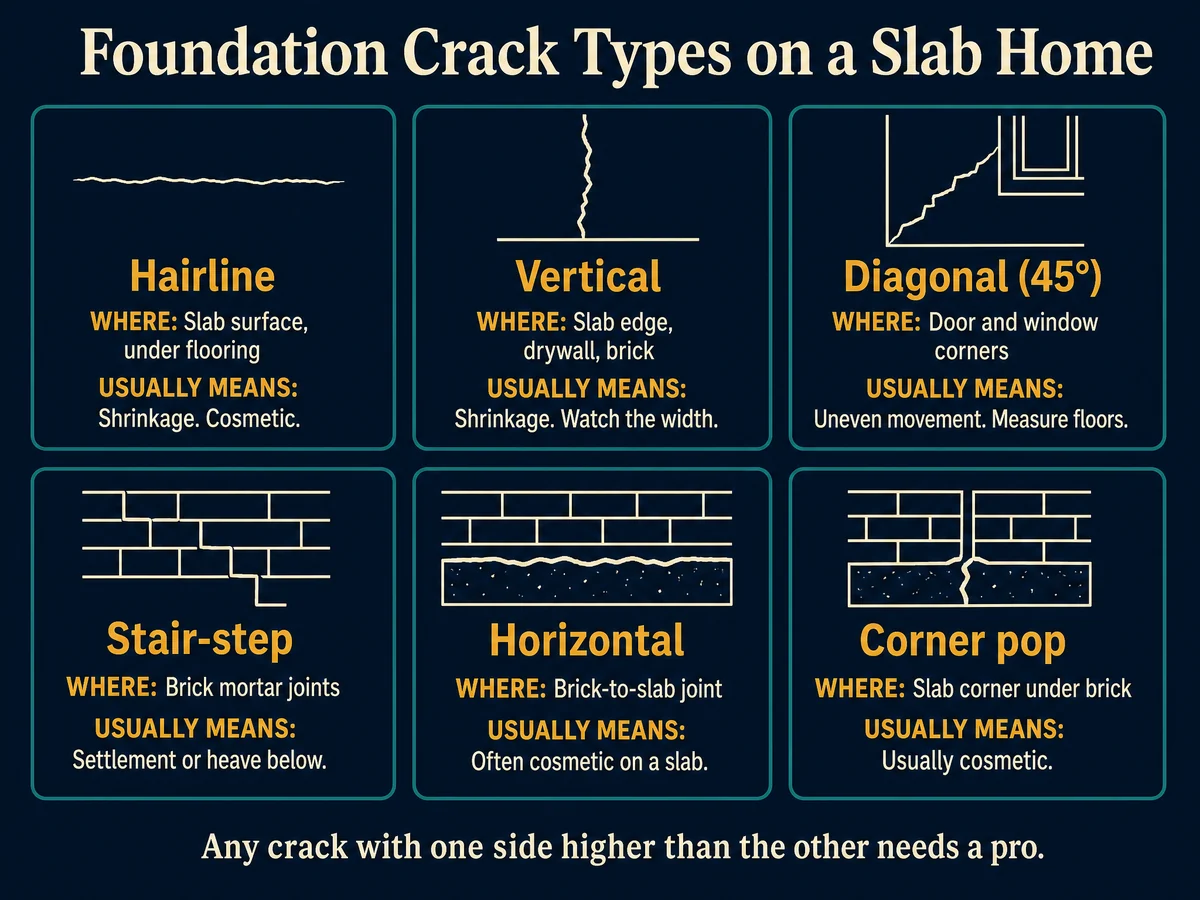
Foundation cracks are sorted by direction, location and shape, because each one points to a different cause. On a Baton Rouge home, which almost always sits on a concrete slab or on piers, the six you will meet are below.
| Crack type | Where you see it | What it usually means | When to call a pro |
|---|---|---|---|
| Hairline / shrinkage | Slab surface, often found when flooring comes up | Concrete drying as it cured | Wider than about 1/8 in, or one side higher |
| Vertical | Slab edge, drywall, brick | Shrinkage or minor settling | Widening over time or wider at one end |
| Diagonal (about 45°) | From door and window corners, in drywall or brick | Uneven movement of the slab | Tapering, growing, with sticking doors |
| Stair-step | Brick mortar joints | Settlement or heave under that wall, or a sagging lintel | Over about 1/4 in, or bricks displaced |
| Horizontal | Joint between brick and slab; basement and block walls elsewhere | On a slab: usually material movement. On a basement wall: soil pressure | Bulging, offset, or on any retaining or block wall |
| Corner pop | Small wedge off a slab corner, under the brick | Brick expansion or how the corner was poured | Brick losing support, or the crack keeps opening |
Sources: NAHB (2018), NRMCA CIP 5, BuildingAdvisor, Brick Industry Association TN 18, and the InterNACHI threads quoted below.
Why do foundation cracks form on Baton Rouge slabs?
Foundation cracks form on Baton Rouge slabs for two reasons: concrete shrinks as it dries, and the clay underneath swells when wet and shrinks when dry. The first gives almost every slab a few hairline cracks. The second moves parts of the house at different rates, and that is what produces diagonal and stair-step cracks.
NAHB risk manager Walt Keaveny, a professional engineer and geologist, opened a 2018 presentation to builders with the basics: “All foundations on soil will move,” and slab-on-grade foundations “can be designed to move up to 4.5”” (NAHB Construction Liability and Risk Management Committee, January 8, 2018). He also wrote: “Loss of moisture causes shrinkage cracks. The more the initial moisture, the greater the potential for cracks.”
Baton Rouge clay makes the soil side of that worse. The USDA soil survey of East Baton Rouge Parish rates Sharkey and Tunica clays as high shrink-swell and says Sharkey clay “develops extensive shrinkage cracks as it dries” (USDA SCS, Soil Survey of East Baton Rouge Parish, 1968). An LSU and Eustis Engineering study put Louisiana’s expansive-soil property losses at $66.2 million a year, highest in the southeast of the state (Frontiers in Built Environment, 2021).
Timing matters too. East Baton Rouge Parish was 100% in drought on the October 20, 2026 Drought Monitor map, and The Advocate reported no rain in the city since September 22 (U.S. Drought Monitor county statistics). Cracks often open in a dry fall and partly close again after winter rain, which is why one reading tells you little. We covered that cycle in foundation cracks after a drought.
What do hairline and shrinkage foundation cracks mean?
Hairline and shrinkage cracks almost always mean the concrete dried and shrank as it cured, not that the house moved. They are the most common of all the types of foundation cracks and usually the least important.
The National Ready Mixed Concrete Association describes plastic shrinkage cracks as forming “soon after it is placed and while it is still plastic,” usually parallel to each other “on the order of 1 to 3 feet apart,” shallow, and not reaching the slab edge. They “are unsightly but rarely impair the strength or durability of concrete floors” (NRMCA, CIP 5). Drying shrinkage cracks appear later, as water leaves the hardened slab. Steve Bliss of BuildingAdvisor says the main cause is “concrete that is too wet,” and that a crack of 1/8 inch or less is typically normal (BuildingAdvisor).
In Baton Rouge, most people find these when old carpet comes up. A Prairieville homeowner on TigerDroppings found 1/8-inch cracks running almost the full length of two bedrooms, with no sticking doors or drywall cracks. Replies, including a poster with 20 years in the concrete industry, called them shrinkage cracks and suggested sealing them against termites and moisture (TigerDroppings, November 2024). Post-tensioned slabs, common in newer subdivisions, are designed to keep these cracks tight; see what a post-tension slab is before you drill or saw one.
What do vertical foundation cracks mean?
A vertical foundation crack usually means shrinkage or minor settling. If it is thin, the same width top to bottom and not growing, it is rarely structural.
What changes the picture is shape and change over time. Bliss says a crack that is “larger or growing larger (an ‘active’ crack)” may need engineering review, and if “one side of the crack is higher than the other, then you may need to have the work reviewed by a structural engineer” (BuildingAdvisor). A vertical crack that is wider at the top than the bottom suggests the ends of the wall are dropping, or the middle is being pushed up, which on Baton Rouge clay happens when one part of the slab dries faster than another.
Measure it before you worry about it. Our step-by-step guide to how to fix foundation cracks shows how to mark, date and measure a crack, and the crack width guide explains what each width usually means.
What do diagonal and stair-step foundation cracks mean?
Diagonal and stair-step cracks mean one part of the house has moved relative to another. They are the types of foundation cracks most closely tied to soil movement, so they deserve the most attention on a Baton Rouge home.
Inside, they run at roughly 45 degrees from the corners of doors and windows, because openings are where walls are weakest. The Foundation Performance Association’s homebuyers’ guide treats diagonal drywall cracks at door and window corners as significant, while hairline cracks and tape-joint lines often are not (FPA-SC-06-0, 2005). Outside, the same movement shows as stair-step cracks along brick mortar joints. The Brick Industry Association says foundation settlement “may cause diagonal/stepped cracking in the brickwork and mortar joints directly above the foundation,” and that “Deflection and settlement cracks are identified by a tapering shape” (BIA Technical Note 18, 2019). Our explainer on stair step cracks in brick covers those in detail.
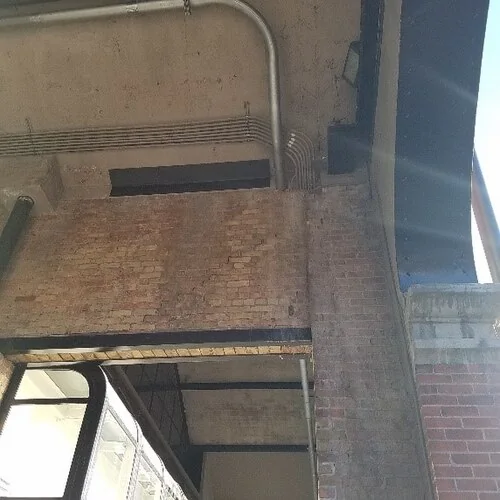
Baton Rouge has one cause most cities don’t: active faults. The Louisiana Geological Survey’s 1981 door-to-door study found that along the Baton Rouge and Scotlandville–Denham Springs faults, brick cracks usually slope northward at about 45 degrees as the south part of the building drops. The same study warned that scattered, irregular cracks away from a mapped fault point to soil or groundwater instead (LGS and Durham Geological Associates, 1981). If your cracks all lean the same way and your street sits near a fault line, read Baton Rouge fault foundation damage.
One diagonal crack is not a diagnosis. Randy Mayo, a licensed engineer and home inspector, told a homeowner on the InterNACHI forum that a diagonal crack means something has moved, but a single crack is only “one puzzle piece”; on a slab, the crack pattern plus a floor-level survey is the reliable way to find the source (InterNACHI forum, August 2024).
What do horizontal foundation cracks mean on a slab home?
On a basement wall, a horizontal crack usually means soil is pushing the wall in, and it is the most serious crack type. On a Baton Rouge slab home, which has no basement wall to push, a horizontal crack is usually at the joint between the slab and the first course of brick, and it is often cosmetic.
Most of what you read online about horizontal foundation cracks comes from basement contractors in cold states, and that advice is right for them. NAHB lists “Horizontal basement wall cracks, especially with bowing or leaning” among the signs of potential structural cracks (NAHB, 2018). The mechanism is lateral pressure from wet or frozen soil against a buried wall. Neither the basement nor the frost applies to a typical Baton Rouge slab.
What Louisiana slab owners do see is a horizontal line where the brick meets the concrete. In a 2007 InterNACHI thread, a Texas inspector found horizontal cracking at the first row of brick on a slab with a cement coating, with doors and windows square. Certified master inspector Kenton Shepard said the crack lined up with the joint where brick mortar meets the concrete, and that the two materials expand and contract at different rates, so a crack forms where they meet. Others agreed it was cosmetic (InterNACHI forum, April 2007). In a Houston thread about a door that started catching during a drought, one reply drew the same line: cracks parallel to the floor and ceiling usually are not foundation-related, but 45-degree cracks are a concern (City-Data, 2011).
The exceptions are a horizontal crack that bulges or is out of line, one in a retaining or block wall, and one on the brick piers or stem wall of a raised house. Those go to a professional. For raised homes, see pier and beam vs slab and what pier and beam foundation repair involves.
What is a corner pop on a slab foundation?
A corner pop is a small triangular piece of concrete that cracks off the corner of a slab, usually under the brick veneer. Inspectors generally treat it as cosmetic.
The cause is debated. In a 2024 InterNACHI thread about a corner crack on a new build, inspector rcloyd called it “Not a structural concern simply cosmetic” and advised: “Leave it alone, if you try to patch it it will look worse.” He blamed concrete placed just before a cold snap; another inspector suspected damage when the forms were stripped, and a third pointed to brick expansion pushing the corner, a cause that only applies where there is brick (InterNACHI forum, March 2024). NAHB’s figures show why brick can do this: a 100-foot outside concrete wall with a 75°F temperature change moves about half an inch (NAHB, 2018).
Worry only if the piece is loose enough that the brick above loses support, or if the crack keeps opening. New-home owners will find more on early cracks in new construction foundation cracks.
Which types of foundation cracks need a professional?
Any crack with one side higher than the other, any crack that keeps growing, and any diagonal or stair-step crack that comes with sticking doors, sloping floors or gaps at trim needs a professional. Width alone is a weak guide, but these are the published limits builders use:
The same NAHB presentation lists six “indications of potential structural cracks”: large cracks and separations, excessive floor deflection or tilt, inoperable doors and windows, excessive wall and surface slopes, “Cracks with vertical displacement”, and horizontal basement wall cracks with bowing or leaning. It quotes an engineering scale by R.W. Day that rates hairline to 1/8 inch as negligible to slight, 3/16 to 9/16 inch as moderate, and over 1 inch as very severe.
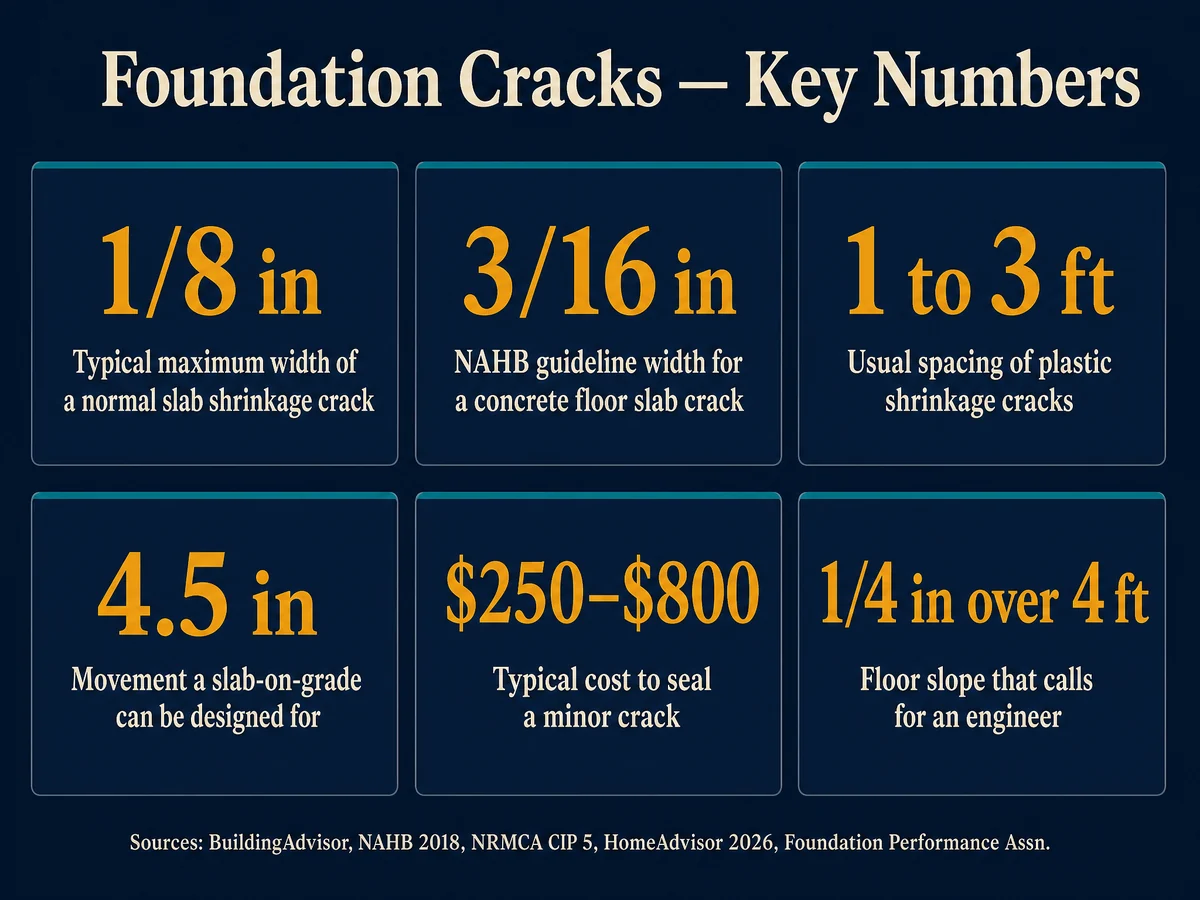
Costs split the same way. Sealing a minor crack typically runs $250 to $800 (HomeAdvisor, June 2026), and This Old House puts a hairline crack caught early at $200 to $800 (This Old House, March 2026). A crack caused by settlement is a symptom; the repair is to the support under the slab, which is a slab foundation repair job, not a tube of sealant. If you are not sure which you have, our free foundation damage assessment walks through the signs.
What have Gulf South homeowners seen with foundation cracks?
Homeowners’ stories show the same pattern: most cracks turn out to be shrinkage, and the ones that matter come with other signs.
- Cracks under the carpet, Prairieville. The 1/8-inch bedroom cracks above came with no sticking doors or drywall cracks, and the advice was to seal and watch (TigerDroppings, 2024).
- A 3-inch gap in a drought. During the 2023 drought, a TigerDroppings poster described a neighbor with “about a 3 inch wide gap in the bricks” at the back door corners, where the worst slab cracks were, with daylight around the closed door. A Baton Rouge poster blamed expansive clay shrinking in the drought; others said gaps closed after rain (TigerDroppings, November 2023).
- A door that won’t close. The owner of a 1963 slab house (in Maryland) had a crack running from a bathroom door frame and a 3/4-inch gap at the door. Mayo’s “one puzzle piece” advice came from that thread, and another inspector suggested measuring the whole house (InterNACHI, 2024).
- A brick fireplace pulling away. A Baton Rouge slab owner had brick cracks over the front door and a firebox separating, with floating vinyl plank flooring that could hide any slab cracks (TigerDroppings, 2021).
Our take: how I’d read a foundation crack in Baton Rouge
Opinion and analysis by Jonathan Dyer, based on the sources above.
In industrial concrete, nobody grades a crack by how alarming it looks. You ask three questions: is it moving, is it offset, and what is it telling you about the load path? That works on houses too, and it cuts through most of the panic around foundation cracks.
So here’s what I’d do. A thin crack in the slab under old carpet, a vertical hairline in the stem, a horizontal line where the brick sits on the concrete, or a small corner pop: I’d photograph it with a ruler, date it, seal slab cracks against moisture and termites, and check it again after the next season change. I wouldn’t spend money on it yet.
A diagonal crack off a door corner, a stair-step crack wider at one end, or anything with one side higher: I’d stop treating the crack as the problem and measure the floor. In Baton Rouge clay, those cracks usually mean one side of the house is wetter or drier than the other, or the slab has settled. A floor-elevation survey tells you which, and whether it’s soil moisture you can manage or movement that needs support.
What I wouldn’t do is let a horizontal-crack article written for a Michigan basement scare me into a wall-anchor quote on a slab house.
What do people get wrong about the types of foundation cracks?
Most mistakes come from reading a crack in isolation:
- Treating every crack as failure. NAHB’s own engineer says most are cosmetic. A slab without a crack is the exception, not the rule.
- Using basement advice on a slab. Horizontal-crack warnings are about buried walls under soil pressure. Baton Rouge homes don’t have them.
- Judging by width only. A 1/16-inch crack that grew last month matters more than a 1/8-inch crack that hasn’t changed in ten years.
- Taking one reading in a drought. Clay is at its driest in a dry fall. Measure again after the winter rains before deciding; our guide to watering your foundation during a drought explains how to keep moisture even meanwhile.
- Ignoring the outside. Downspouts dumping at the slab and trees close to the house drive much of the uneven movement. See tree roots and foundation damage.
- Patching before diagnosing. Sealing a structural crack hides the evidence. Measure first, then decide whether foundation crack repair or deeper work is needed.
For the full list of warning signs beyond cracks, see signs of foundation problems.
Methodology. This explainer is built from published sources, not from a customer project: NAHB's 2018 Construction Liability and Risk Management Committee presentation by Walt Keaveny, P.E. (which summarises NAHB's Residential Construction Performance Guidelines), NRMCA Concrete in Practice 5, the Brick Industry Association's Technical Note 18, the Foundation Performance Association's homebuyers' guide, the 1981 Louisiana Geological Survey fault damage study, the 1968 USDA soil survey of East Baton Rouge Parish and U.S. Drought Monitor county data. Costs come from HomeAdvisor (June 2026) and This Old House (March 2026). Homeowner and inspector stories are paraphrased from public TigerDroppings, City-Data and InterNACHI threads. Search demand was checked with DataForSEO (October 2026: "types of foundation cracks", about 390 searches a month nationally; "horizontal foundation cracks" about 1,000; "vertical foundation cracks" about 880). Reddit could not be reached from our research tools, so no Reddit posts are used. Images marked "Illustration" are AI-generated graphics, not photos of real work.
Not sure which crack you have?
Book a free evaluation. We map and measure every crack, take laser floor elevations across the slab, and tell you in writing which cracks are cosmetic and which point to movement. Request a free evaluation or book a foundation inspection in Baton Rouge.