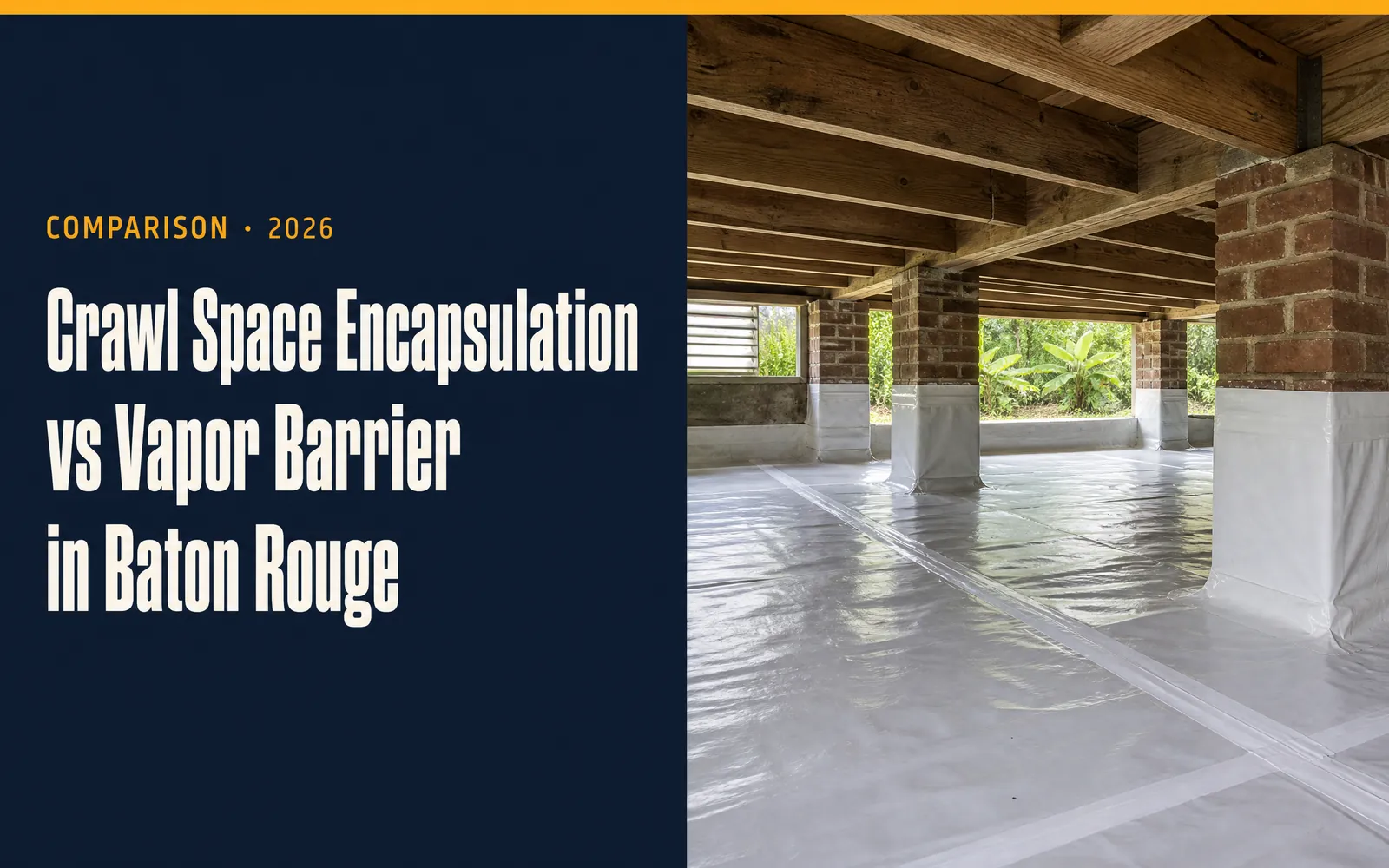
Crawl space encapsulation vs vapor barrier: which does a Baton Rouge home need? A vapor barrier is a ground cover with the vents left open. Encapsulation seals and dries the whole crawl space. In Baton Rouge's humid air, encapsulation controls moisture far better, but only on a walled, dry crawl space outside the flood-opening rules.
Key Takeaways
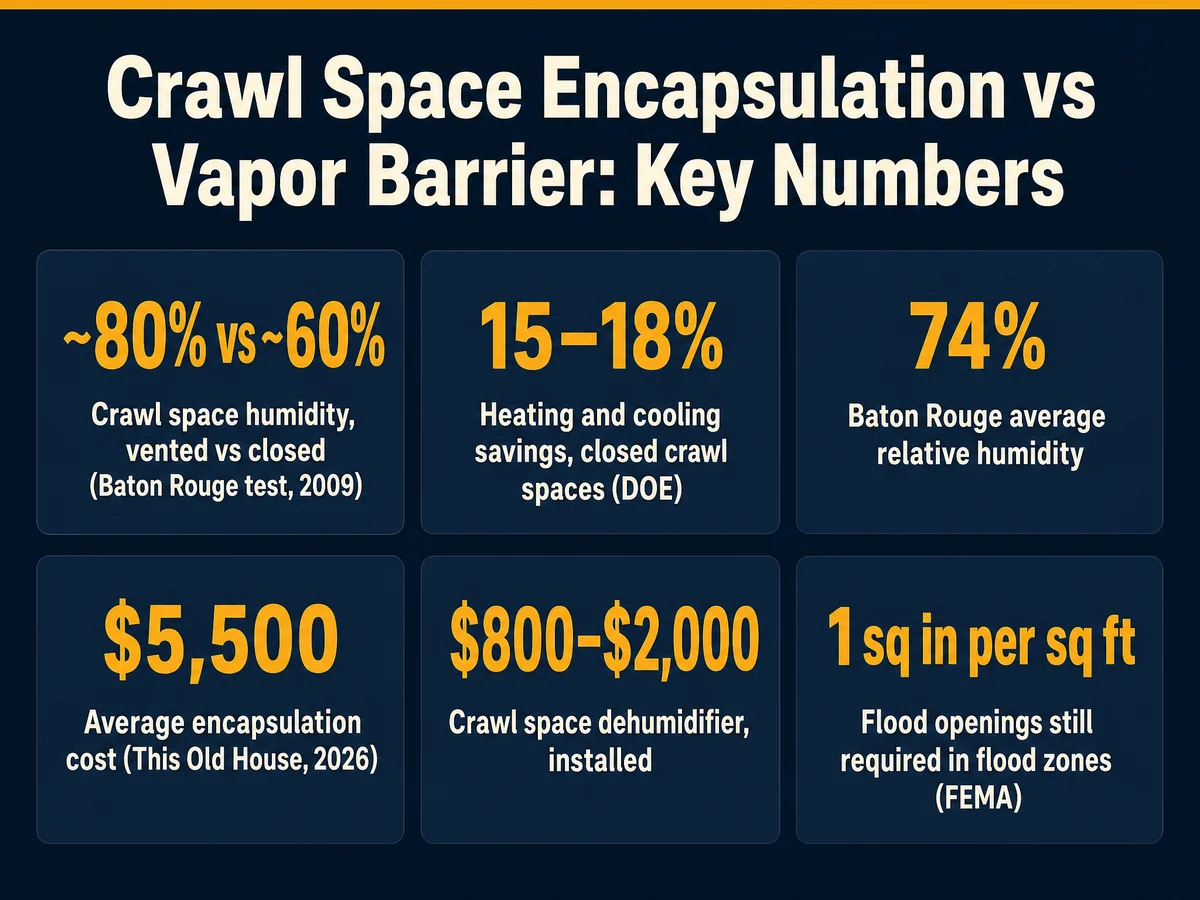
- In a 2009 federally funded test with Baton Rouge sites, closed crawl spaces held relative humidity near 60% on a daily average, while vented ones hovered around 80% for most of spring and summer — Advanced Energy, via WATERPROOF! Magazine
- In 12 south Louisiana houses (4 in Baton Rouge), crawlspace vapor pressure "was essentially the same as outdoor vapor pressure" from May to October — LSU AgCenter and USDA Forest Products Laboratory, 2010
- Unvented crawl spaces cut heating and cooling energy by 15% to 18% in Building America research — U.S. Department of Energy
- Encapsulation averages $5,500 (range $1,500–$15,000), and a dehumidifier adds $800–$2,000 installed — This Old House, March 2026
- "In SFHAs, all crawlspaces must have flood openings," sealed conditioned crawlspaces included — FEMA Technical Bulletin 1, 2020
- Formosan termites cause about $500 million in damage a year in Louisiana, and damage "may be concealed for months, or even years" — LSU AgCenter Pub. 2840
What is a crawl space vapor barrier?
A crawl space vapor barrier is a sheet of polyethylene laid over the dirt under a raised house to stop ground moisture evaporating into the crawl space. The foundation vents stay open, so outside air still moves through the space.
Louisiana builds to the 2021 International Residential Code, which the state’s uniform construction code council adopted with an effective date of January 1, 2023. In a vented crawl space, the code asks for 1 square foot of vent opening per 150 square feet of floor. It lets that drop to 1 per 1,500 “where the ground surface is covered with an approved Class I vapor retarder material” (IRC R408.2, Louisiana Residential Code). So in code terms, a vapor barrier is the ground cover that a vented crawl space should already have.
On a pier and beam house, a vapor barrier is the cheapest moisture fix there is. It is also the first thing a contractor installs before any wood repair, because new joists and sills rot just as fast as the old ones if the dirt below them stays wet.
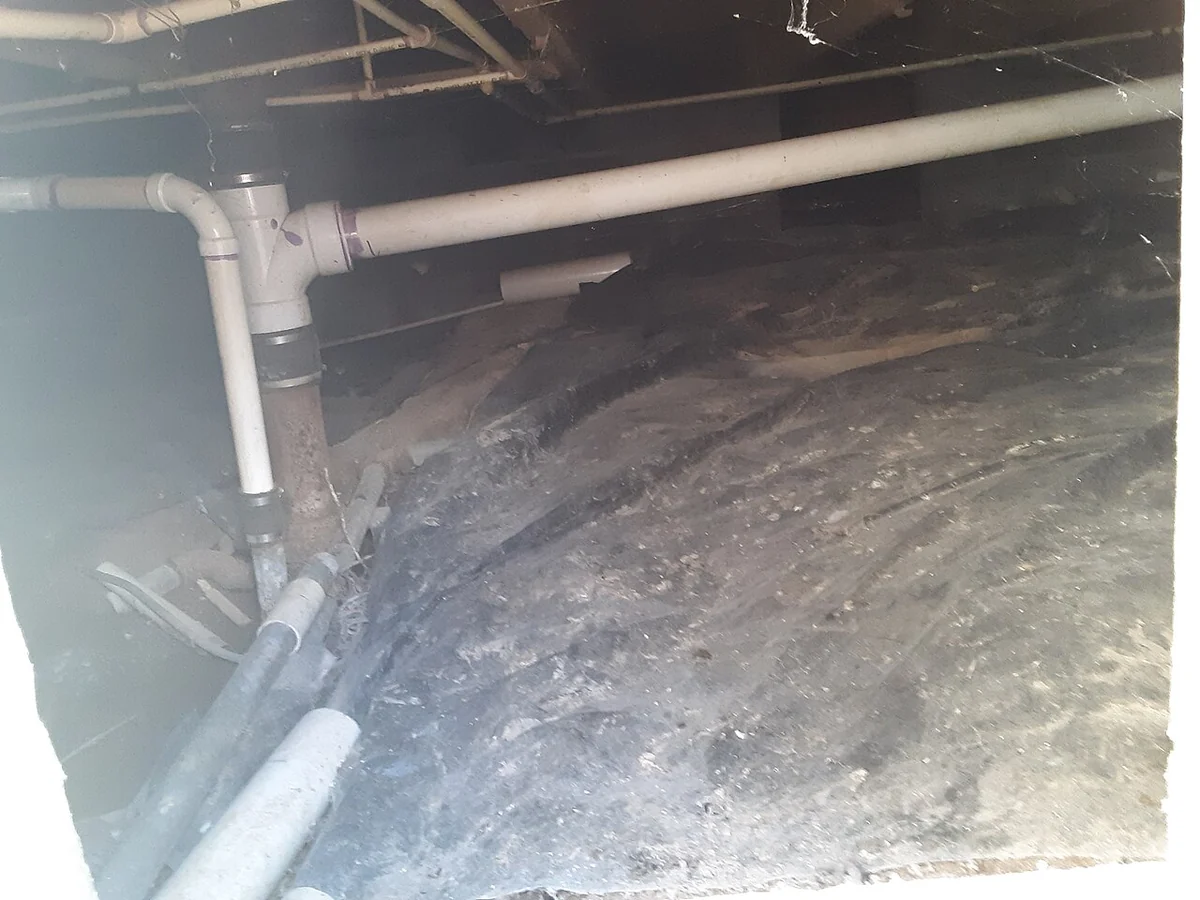
What is crawl space encapsulation?
Crawl space encapsulation turns a vented crawl space into a closed, unvented one. The ground and walls get a continuous liner, the vents are sealed, and the air inside is kept dry by mechanical means.
The code spells out the minimum in its unvented crawl space section. Exposed earth “shall be covered with a continuous Class I vapor retarder.” Joints overlap 6 inches and are sealed or taped, and the edges run at least 6 inches up the stem wall and are sealed to it (IRC R408.3). The space then needs one of four drying methods: continuous exhaust, a supply of conditioned air, a plenum, or “dehumidification sized in accordance with manufacturer’s specifications.”
That last part is what separates encapsulation from just using thicker plastic. A sealed crawl space with no way to dry it has nowhere to send moisture. Building scientist Allison Bailes makes the reverse point: a dehumidifier in a vented crawl space over bare dirt is wasted money, because it is trying to dry the outdoors.
How does crawl space encapsulation compare to a vapor barrier in Baton Rouge?
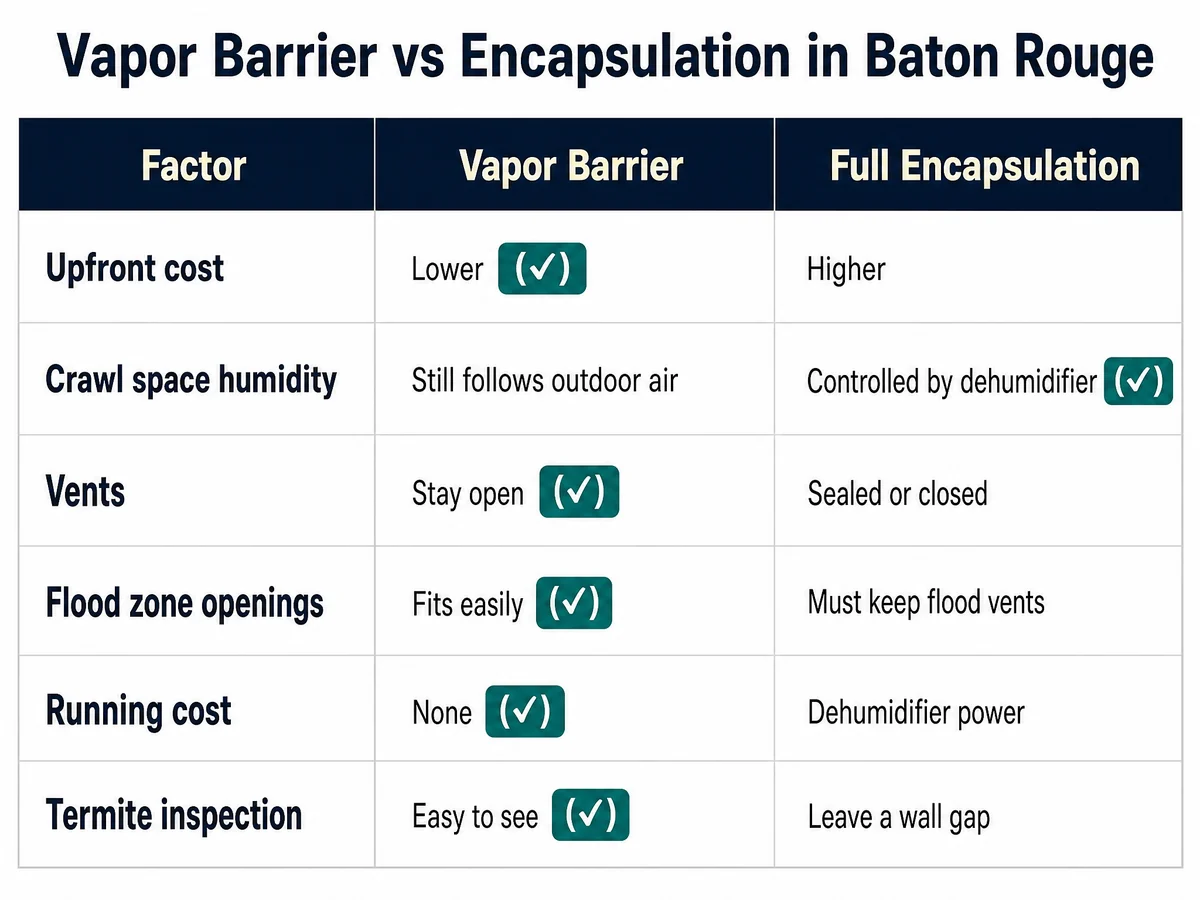
A vapor barrier wins on upfront cost, running cost, flood-opening rules and how easily the space can be inspected. Encapsulation wins on humidity control and energy savings. Here is the side-by-side:
| Factor | Vapor barrier (vented) | Full encapsulation (unvented) |
|---|---|---|
| What it covers | Dirt floor | Floor and walls, vents sealed |
| Code section | IRC R408.2 (vented) | IRC R408.3 (unvented) |
| Summer crawl space humidity | Tracks outdoor air (about 80% in the Baton Rouge test) | Held near 60% in the Baton Rouge test |
| Typical cost | Material $0.05–$0.60 per sq ft; one 20 mil liner quote $1,500 | Average $5,500; range $1,500–$15,000 |
| Running cost | None | Dehumidifier electricity, filters, service |
| Flood zone (SFHA) | Flood openings fit easily | Flood openings still required in the sealed walls |
| Termite inspection | Wood and piers stay visible | Liner and foam must stop short of the wood |
| Needs a perimeter wall? | No, works under open piers | Yes |
Sources: humidity from Advanced Energy’s Baton Rouge test; costs from This Old House (2026) and a GreenBuildingAdvisor homeowner quote (2016); flood openings from FEMA Technical Bulletin 1.
Why does Baton Rouge humidity matter for a crawl space?
Baton Rouge humidity matters because, for half the year, the outdoor air is wetter than the air inside the house. Vents bring that air under the floor, where it meets wood cooled by the air conditioning above.
Baton Rouge averages 74% relative humidity across the year and 77% in July, with July mornings averaging 91% (CurrentResults, NOAA-based normals). WeatherSpark’s Baton Rouge records put the chance of a muggy day at 99% in late July.
The most local evidence comes from a study of raised floors in south Louisiana. Researchers from the USDA Forest Products Laboratory and LSU AgCenter monitored 12 houses, 8 in New Orleans and 4 in Baton Rouge, for a year in 2008-09. Their finding: “In all houses, crawlspace vapor pressure was essentially the same as outdoor vapor pressure and exceeded indoor vapor pressure from May to October” (Glass, Carll, Curole and Voitier, 2010). In other words, a vented crawl space here is the outdoors with a floor over it, and a vapor barrier alone does not change that.
Building Science Corporation’s Joseph Lstiburek put the problem bluntly in a 2004 Building America report: crawl space venting is seen as good practice “despite the obvious moisture problems that occur when outside air with a dew point higher than interior crawl space surface temperature is permitted to enter a crawl space” (Building Science Corporation). The EPA’s target for indoor air is below 60% relative humidity, ideally 30% to 50%.
What does the Baton Rouge crawl space encapsulation research show?
The research shows that closed crawl spaces stay drier and use less energy, and Baton Rouge was one of the test sites. Advanced Energy, a North Carolina research group, ran a federally funded closed crawl space study in 2009 with test sites in Baton Rouge and Flagstaff.
“In Baton Rouge, the results were very clear that closed crawl spaces dramatically affect relative humidity,” building scientist Cyrus Dastur told WATERPROOF! Magazine. The closed systems held crawl space humidity “closer to 60% on a daily average, while the control group humidity hovered around 80% for most of the spring and summer months.” Project director Bruce Davis added the caveat that matters most: “Before you even can talk about closed or vented, you have to deal with the liquid water first.”
The earlier North Carolina field study behind the code change found closed crawl spaces saved “an average of 15% or more” on heating and cooling energy (OSTI, 2008 summary). The U.S. Department of Energy now lists 15% to 18% savings and over 20% lower humidity as a Building America result. One caution: those studies tested walled crawl spaces. An open-pier house can’t be closed the same way, so it won’t see the same gain.
How much does crawl space encapsulation cost vs a vapor barrier?
Encapsulation usually costs several times as much as a vapor barrier, and it adds a running cost. This Old House puts encapsulation at an average of $5,500, with a range of $1,500 to $15,000, or $3 to $7 per square foot for basic jobs and up to $10 with heavy moisture (This Old House, March 2026).
| Item | Published cost | Source |
|---|---|---|
| Full encapsulation, average | $5,500 (range $1,500–$15,000) | This Old House, 2026 |
| Encapsulation per sq ft | $2–$4 basic; $3–$10 extensive | HomeAdvisor, June 2026 |
| Vapor barrier material | $0.05–$0.20/sq ft (4 mil) to $0.40–$0.60/sq ft (20 mil) | This Old House, 2026 |
| Crawl space dehumidifier, installed | $800–$2,000 | This Old House, 2026 |
| Crawl space drainage system | $600–$1,800 | This Old House, 2026 |
| Homeowner quotes, South Carolina | $6,000 encapsulation vs $1,500 for a 20 mil liner only | GreenBuildingAdvisor, 2016 |
Local numbers are thin. A Baton Rouge poster on TigerDroppings put a crawl space dehumidifier at about $1,500 to $2,000 (October 2024), with the full job “likely several thousand, in BR anyway.” Running cost depends on the unit and the season. One homeowner measured about 2.6 to 3.4 kWh a day in a mild California climate (GreenBuildingAdvisor, 2021). A Baton Rouge summer will push that higher, so ask for the unit’s rated draw. Our pier and beam repair cost guide and the crawl space repair page show how moisture work fits next to leveling and wood repair.
Can you encapsulate a crawl space in a Baton Rouge flood zone?
Yes, but you cannot seal it completely. If the house is in a FEMA Special Flood Hazard Area, the crawl space walls must keep flood openings that let water in and out, so the foundation isn’t pushed over by water pressure.
FEMA’s Technical Bulletin 1 is explicit: “CONDITIONED CRAWLSPACES MUST HAVE FLOOD OPENINGS… In SFHAs, all crawlspaces must have flood openings that meet the NFIP requirements and building codes.” It also warns that “ventilation openings are too far above grade to satisfy flood opening requirements” in most cases (FEMA TB-1, March 2020). The NFIP rule calls for at least two openings with one square inch of net area per square foot of enclosed area, the bottoms no higher than one foot above grade. Louisiana’s residential code repeats the requirement for crawl spaces in flood hazard areas (IRC R408.7).
Any opening used in a sealed wall still has to meet TB-1, so ask for the flood vent’s certification and confirm it with the parish floodplain office before anyone seals a vent. If the crawl space flooded in 2016 or since, start with foundation damage after a flood and check what flood insurance covers. For houses that keep flooding, house raising may be the better use of the money.
Does encapsulation hide termite damage in Louisiana?
It can, if the liner or wall insulation covers the masonry right up to the wood. Formosan subterranean termites “attack homes from below and rarely break through the surface of wood,” says LSU AgCenter Publication 2840. It puts their damage at $500 million a year in Louisiana and their range mainly in parishes south of Interstates 10 and 12. It tells homeowners to routinely inspect “attics, crawl spaces and garages.”
Moisture is what lets termites settle in. “Now what will allow them to establish in the home is the moist conditions,” LSU AgCenter entomologist Dr. Aaron Ashbrook told the Louisiana Radio Network in May 2024. That cuts both ways: a drier crawl space helps, but a liner that hides the mud tubes hurts.
Two rules help. Louisiana’s residential code requires foam plastic installed above grade to sit at least 6 inches above exposed earth (IRC R318.4). North Carolina, where closed crawl spaces are common, requires the wall liner to stop 3 inches below the top of the masonry wall as a “termite inspection gap” (NC Office of State Fire Marshal). Louisiana has no such rule that we could find, so ask for the gap anyway, and keep your termite contract active.
When should you choose a vapor barrier?
Choose a vapor barrier when the house sits on open piers with no perimeter wall, when it’s in a flood zone and you don’t want to manage flood vents, or when the budget is tight and the main problem is damp soil. It’s also the right first step on any crawl space you’re not ready to seal.
Do it properly: cover all the dirt, overlap seams 6 inches and tape them, run the plastic up the piers, and fix the water first. Re-grading, gutters and foundation drainage matter more than the plastic. Our hurricane season drainage checklist covers the outside work. On open-pier houses, the floor itself is the air barrier, so seal and insulate the subfloor with a moisture-safe material. The LSU-Forest Products Lab study found foil-faced polyiso board kept subfloor moisture at 10–14%, while open-cell foam and kraft-faced batts read above 20%.
When should you choose crawl space encapsulation?
Choose encapsulation when the crawl space has a continuous perimeter wall, stays dry after heavy rain, and has ducts, an air handler or water lines under the floor. Those houses gain the most from a crawl space held near 60% humidity, and the energy savings help pay for the dehumidifier.
It also makes sense where wet wood is already the problem: musty smells, cupping floors, sagging floors or rotted sill plates. Fix the structure and the water first, then seal. And if the house is out of level, level it before the liner goes in, because house leveling means crawling, jacking and cribbing all over the crawl space.
What have Louisiana homeowners said about vapor barriers vs encapsulation?
Gulf South homeowners split on this question, and the deciding factor in most stories is standing water, not plastic thickness.
- A barrier that held water. On a 2025 TigerDroppings thread about a 2010 pier and beam home in metro New Orleans, a poster who owned a pier and beam house for 12 years said he pulled his barrier out after storm water and a burst pipe left water sitting on top of it. His advice was to fix the grading first, then fully encapsulate with a professional dehumidifier. A Baton Rouge poster in the same thread said gutters and slope matter most.
- A vapor barrier that was enough. In an October 2024 thread, a homeowner with a large crawl space said they installed a vapor barrier only and “it made a massive difference.” Another poster warned that closed-cell foam under the whole floor can turn the crawl space into a water pan if water gets in.
- Skeptics of sealing open piers. When a Louisiana homeowner with brick piers and puddling after rain asked about building walls and encapsulating (2019), most replies were wary. One wrote: “If you can’t regulate the humidity in the space then it is a bad idea that can and will cause rot and mold.” A River Parishes poster suggested insulating the subfloor instead.
- New Orleans open-pier house. On GreenBuildingAdvisor (2022), responders told a New Orleans owner not to wall in and encapsulate an open block-pier house. The owner planned to air-seal the floor and add foam board, citing the LSU AgCenter raised-floor guidance.
If you’re buying a raised house, have someone look in the crawl space before closing. Our guide to buying a house with foundation repair covers what to check, and pier and beam vs slab explains why the crawl space is the main upkeep item on a raised house.
Our take: vapor barrier or encapsulation for a Baton Rouge crawl space?
Opinion and analysis by Jonathan Dyer, based on the sources above.
In industrial repair work, the rule is that you don’t coat a wet substrate. You find where the water comes from and stop it, and only then do you seal. A crawl space works the same way. The Baton Rouge data is clear that a closed, dried crawl space beats a vented one on humidity. The forum stories are just as clear that sealing a crawl space that still takes on water makes things worse.
So here’s what I’d do. First, I’d go under the house after a heavy rain. If there’s standing water, the money goes to grading, gutters and drainage before any plastic, and a French drain installed with a real outlet if water still seeps in. Next, on a walled crawl space that stays dry, with ducts or plumbing under the floor and no flood-zone restriction, I’d encapsulate it properly: 10 to 20 mil liner, taped seams, a sized dehumidifier, and a visible strip of masonry left at the top of the wall for termite checks.
On an open-pier house, or in a flood zone where I’d have to keep flood openings anyway, I’d put down a good vapor barrier, seal and insulate the floor from below with a moisture-safe board, and stop there. That is not the cheap option. It’s the one that fits how the house was built.
What goes wrong with crawl space vapor barriers and encapsulation?
Most failures come from sealing before the water problem is fixed, or from skipping the drying part of encapsulation:
- Plastic over standing water. A barrier that collects water from above holds it against the dirt and the piers. Fix the drainage first.
- Sealing vents with no dehumidifier. The code requires a drying method for an unvented crawl space. Without one, Baton Rouge summer moisture has nowhere to go.
- Running a dehumidifier in a vented crawl space. It tries to dry outdoor air and runs constantly.
- Blocking required flood openings. In a Special Flood Hazard Area this breaks the NFIP rules and can affect a flood claim.
- Covering the wall to the sill. It hides termite tubes. Leave an inspection strip.
- Ignoring the structure. Encapsulation does not fix sagging joists or failed piers. Have the floor measured first with a foundation inspection, and see how to fix sagging floors for the framing repairs that come before the liner.
Methodology. This comparison is built from published sources, not from a customer project: Louisiana's adopted 2021 residential code (IRC R408, R318.4), FEMA Technical Bulletin 1 and the NFIP flood-opening rule, Advanced Energy's federally funded closed crawl space studies (including the 2009 Baton Rouge test sites), the U.S. Department of Energy's Building America summary, the 2010 LSU AgCenter and USDA Forest Products Laboratory study of 12 south Louisiana raised floors, LSU AgCenter termite guidance, EPA mold guidance, Baton Rouge humidity normals, and 2026 cost guides from This Old House and HomeAdvisor. Search demand was checked with DataForSEO in October 2026: "encapsulation vs vapor barrier" and "vapor barrier vs encapsulation" each get about 260 U.S. searches a month, and "crawl space encapsulation vs vapor barrier" about 140. The top 10 results from Baton Rouge were all crawl space contractors in other states. Homeowner experiences are paraphrased from public forum posts and linked to their sources. No customer stories, quotes or jobs are invented. The hero, chart and stats images are AI-generated illustrations; the crawl space photo is a licensed Wikimedia Commons image.
Not sure what your crawl space needs?
Book a free evaluation. We check the crawl space for standing water, wood moisture and failed piers, take laser elevations across the floor, and give you a written price for the moisture fix and any structural repair. Request a free evaluation or read more about crawl space repair in Baton Rouge.