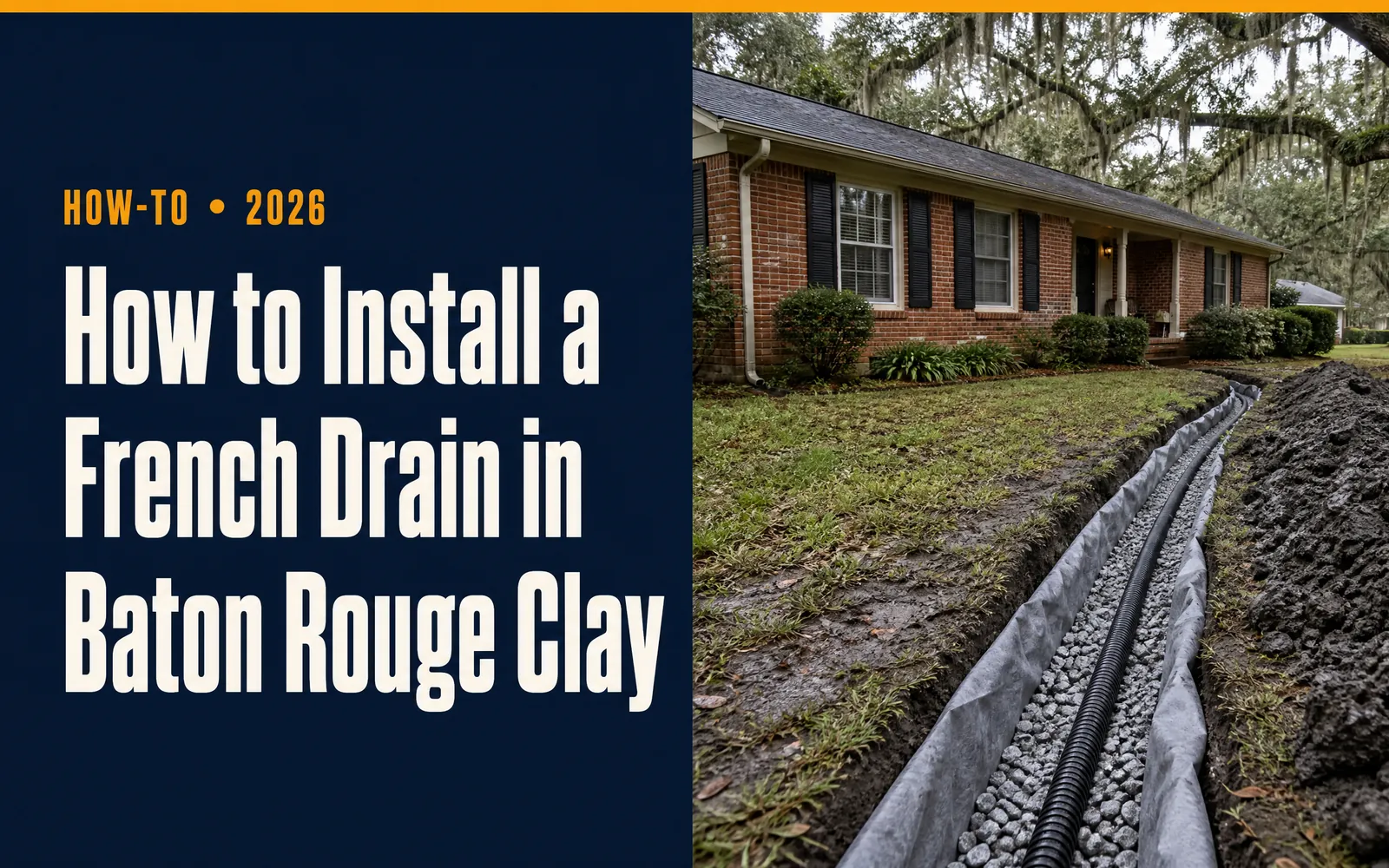
How to install a French drain in Baton Rouge clay? Find where the water collects, plan an outlet lower than the drain, dig a trench about 3 feet off the slab with a steady 1 to 2 percent fall, lay fabric, gravel and perforated pipe, and keep roof water in its own solid pipe.
Key Takeaways
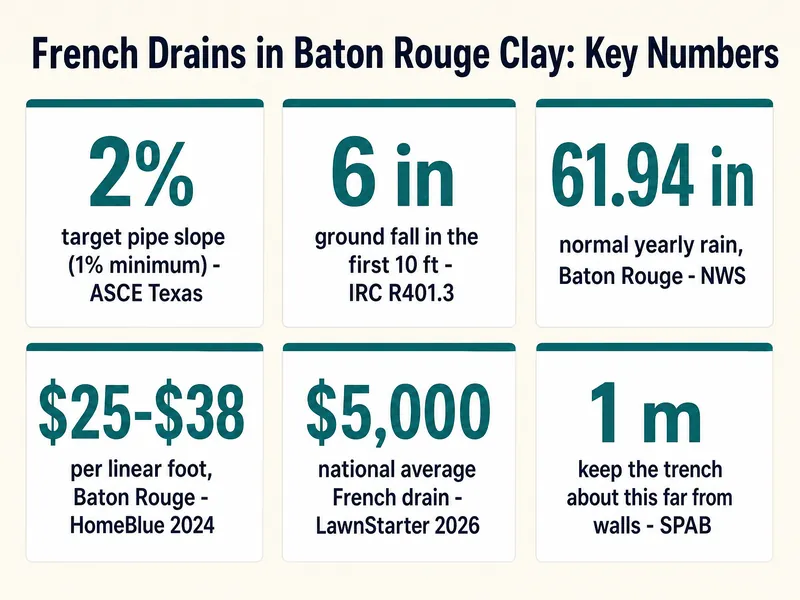
- Engineers' repair guidelines call for a continuous drain slope of 2 percent where practicable and 1 percent at a minimum, with cleanouts — ASCE Texas Section, 2022
- The same guidelines say downspouts and surface drains "should not be connected to perforated pipe subsurface drainage systems" — ASCE Texas Section
- Keep the trench about a metre (3 feet) from walls and outside a 45-degree line from the bottom of the footing — Douglas Kent, SPAB
- Baton Rouge's normal rainfall is 61.94 inches a year, much of it landing on slow-draining clay — National Weather Service
- French drains in Baton Rouge run about $25 to $38 per linear foot; the national average job is about $5,000 — HomeBlue, 2024, LawnStarter, 2026
- Louisiana law says the uphill owner "may not do anything to render the servitude more burdensome" on the lot below — La. Civil Code Art. 656 (Acts 2017, No. 105)
What does a French drain do on Baton Rouge clay?
A French drain is a sloped trench of gravel with a perforated pipe in it. It catches water moving through the soil and carries it to an outlet. On Baton Rouge clay, its job is narrower than most DIY videos suggest: it intercepts water that runs across the top of the dense clay and moves it away before it soaks the soil under your foundation.
That matters because the soil here shrinks and swells. The USDA soil survey of East Baton Rouge Parish rates clays such as Sharkey as high shrink-swell, and says much of the foundation damage here comes from those soils wetting and drying. A drain that keeps one side of the house from staying soggy helps the clay under the slab stay closer to even, which is what keeps a slab still. Our foundation drainage service is built around that idea.
The catch is that clay drains very slowly. The gravel trench cannot “soak” water into clay the way it can in sand. If a French drain in clay has no outlet, it becomes a long, narrow pond next to your house.
Do you need a French drain, or just better grading?
Most Baton Rouge homes need better grading and downspout lines first, and a French drain only where water still collects after that. Fix surface water at the surface; use a French drain for water that moves under it.
The International Residential Code section R401.3 requires the ground to fall at least 6 inches in the first 10 feet away from the foundation, as InterNACHI’s summary of the code explains. The ASCE Texas Section’s Guidelines for the Evaluation and Repair of Residential Foundations (Version 3, adopted 2022) use the same 5 percent figure. They say solid pipe should carry surface water when grading cannot, and perforated subsurface drains are “appropriate to control subsurface water.”
Home inspectors on the InterNACHI forum gave the same advice to a homeowner with a yard sloping toward the house over clay: a swale or regrade that stops water reaching the structure is “the sure fix,” and a French drain is the backup when that is not practical. Our French drain vs swale comparison covers costs, slopes and when a flat lot needs both.
| Option | What it handles | Best for | Typical cost signal |
|---|---|---|---|
| Regrade (6 in fall in 10 ft) | Rain landing near the house | Beds and lawns that slope toward the slab | Lowest, mostly labor |
| Swale | Sheet flow across the yard | Water running in from a neighbor or the street side | Low |
| Solid-pipe downspout line | Roof water | Downspouts dumping at the slab | Starts around $1,000 installed (our drainage page) |
| Catch basins + solid pipe | Ponding in one spot | Low spots in a flat yard | About $2,000 for 130 ft, one forum quote |
| French drain (perforated) | Water moving through the soil | Soggy strips, seepage under a crawl space, runoff over clay | $25-$38 per ft in Baton Rouge (HomeBlue) |
If you’re not sure which you have, the hurricane-season drainage checklist is a good walk-around, and our guide on how to fix a settling foundation explains why drainage comes before pilings.
What do you need before you install a French drain?
You need a plan on paper, a free utility locate and a way to set slope. The tools are simple; the planning is what makes it work in clay.
- A route and an outlet. Sketch the house, the wet area and the lowest point on your lot that can legally take the water.
- A way to set fall. A string line and line level, a 4-foot level with a short scrap of pipe, or a rented laser.
- Digging power. A trenching shovel works for short runs. Louisiana DIYers on TigerDroppings mostly rented a trencher or mini excavator for long ones.
- Materials. Non-woven filter fabric, washed gravel, 4-inch perforated pipe, solid pipe for any downspouts, fittings, a cleanout and a pop-up emitter or open outlet.
- A call to 811. Louisiana 811 is free. A 2025 WAFB report on Louisiana 811 Day says to call “at least a couple of days ahead of time,” and quotes officials’ estimate that an underground line is damaged every couple of minutes by someone digging without calling. You can also file a ticket through Louisiana One Call.
How do you install a French drain, step by step?
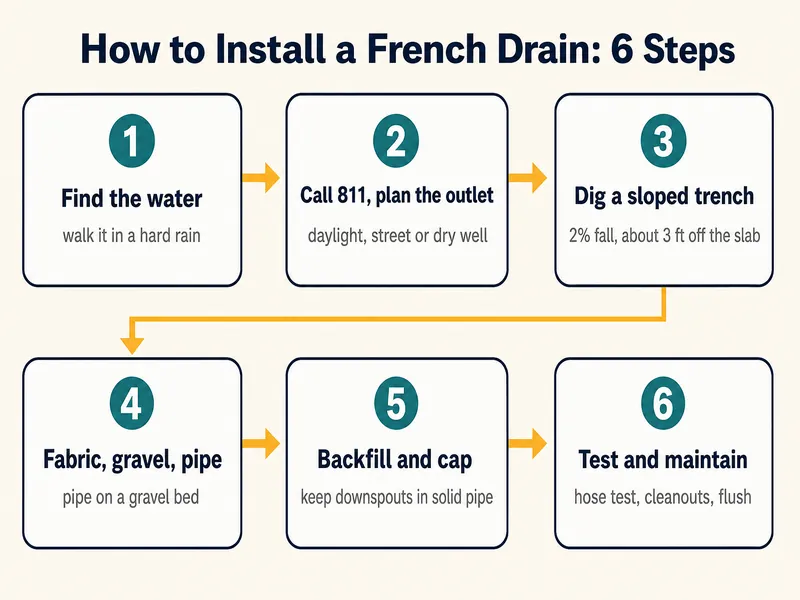
Install it in six steps: find the water, plan the outlet, dig a sloped trench, build the drain, backfill, then test it. Do them in order; most failures come from skipping step 2.
Step 1: Where is the water coming from?
Watch the house in a hard rain, or run a hose into the downspouts and across the yard if it is dry. Note where water ponds, which side of the house stays wet longest and where each downspout empties. Mark the wet strip with flags.
On a slab house, look for water standing against the beam, soil washing out at a corner, or a bed that stays muddy for days. On a raised house, look under it: water pooling in the crawl space after rain is a classic French drain job, and our crawl space repair page and encapsulation vs vapor barrier guide cover what that water does to the framing.
Step 2: Where will the French drain empty?
Decide the outlet before you dig a single shovelful. In clay, the outlet is the drain. Water has to leave the pipe at a point lower than where it enters, at a steady fall the whole way.
Typical outlets are daylight (the pipe exits on a lower part of your lot), the street or a roadside ditch, or a dry well far from the house. Check the numbers on a flat lot. At 1 percent, a 100-foot run needs a full foot of drop; at 2 percent it needs two feet. On a flat lot that much fall can be hard to find, which is why the route and the outlet decide the depth.
Louisiana law adds a limit. Under Civil Code Article 655, the lower lot must accept surface water that flows naturally from the higher one. But Article 656, as amended in 2017, says the owner above “may not do anything to render the servitude more burdensome.” Concentrating your yard’s water into a pipe aimed at a neighbor’s lot is the kind of thing that starts that argument. Send it to the street, a ditch or your own lower ground, and check local rules before cutting a curb.
Step 3: How deep and how far from the slab should you dig a French drain?
Dig about 3 feet out from the slab, deep enough to catch the water but never below a 45-degree line drawn down and out from the bottom of the foundation. That rule keeps the trench from undermining the soil that holds the beam up.
Douglas Kent, technical secretary of the UK’s Society for the Protection of Ancient Buildings, puts it plainly: a French drain “should be positioned a metre or so away from walls,” and the trench “must not encroach within a 45° downward angle from the bottom of the foundations.” His typical trench is 150 to 200 mm wide by 200 to 300 mm deep (about 6 to 8 inches by 8 to 12 inches), with a fall of about 1 in 80.
For deeper drains, Bob Vila’s French drain cost guide puts the trench at about 18 to 24 inches below the area you want to protect. The ASCE Texas guidelines set the fall: a continuous 2 percent if practicable, 1 percent minimum. That is roughly 1/4 inch per foot, or 1/8 inch at the least.
Set the fall as you go. A TigerDroppings poster in a 2021 Baton Rouge yard-drainage thread suggested digging a pilot trench, then checking 4 to 6 feet at a time with a length of solid pipe and a 4-foot level. Another used a string line dropping 1 to 2 inches every 10 feet, which is on the shallow side of the ASCE figure.
Never dig under the slab edge, and never cut into a post-tension slab’s beam or tendon ends. Our post tension slab guide explains why. If a tree root is in the way, read how tree roots affect Baton Rouge foundations before cutting it.
Step 4: How do you lay the fabric, gravel and pipe?
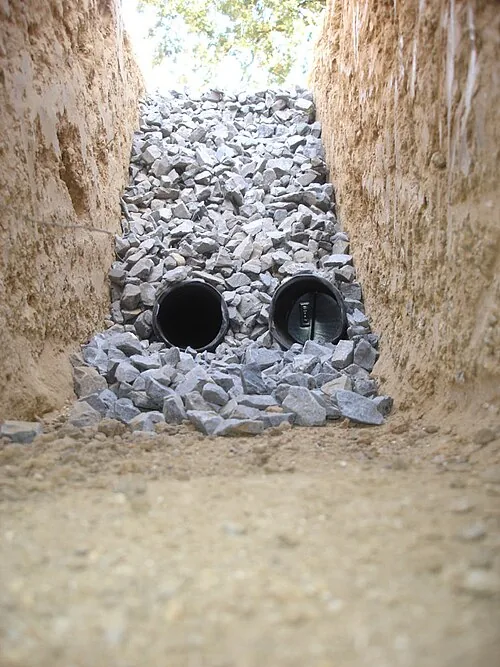
Line the trench with non-woven filter fabric, put in a bed of washed gravel, set the perforated pipe on it, cover the pipe with more gravel and fold the fabric over the top like a burrito. The fabric is what stops Baton Rouge clay from silting up the gravel.
The ASCE Texas guidelines describe a subsurface drain as “perforated pipe, with or without filter fabric, in an aggregate-filled trench,” with cleanouts for maintenance. A homeowner on TigerDroppings described the same basic build: trench, perforated pipe in a filter sock, then gravel and topsoil, running to woods on the property, and said it “works great.”
Fabric is not a settled question in clay. On Permies, an Arkansas owner who ran two 4-inch perforated pipes across the front of a slab building said his fabric clogged, so he pulled it and the drain worked for about 10 years. On the same thread, a landscaper quoted by the original poster argued against French drains because clay fills the gravel. In sticky clay, wrapping the whole gravel envelope, not just the pipe, and fitting a cleanout so the pipe can be flushed is the safer bet.
Step 5: How do you backfill and keep roof water out?
Cap the gravel with soil and sod shaped so the surface still falls away from the house, and keep every downspout in its own solid pipe. A French drain is for groundwater, not roof water.
This is the step installers most often get wrong. The ASCE Texas guidelines say “downspouts and surface drains should not be connected to perforated pipe subsurface drainage systems.” A downspout dumps hundreds of gallons into a pipe in a storm. If that pipe is perforated and runs along your foundation, the roof water can leave through the holes right where you are trying to keep the clay even. Solid PVC from each downspout to the outlet avoids that. Our foundation drainage page shows how we run the two systems side by side.
Don’t bury the drain under a bed mounded against the brick, and don’t let mulch or fill build the grade back toward the slab. The 6-inches-in-10-feet rule still applies on top of the drain.
Step 6: How do you test and maintain a French drain?
Test it before you call it done: run a hose into the high end and watch the outlet. Water should show up at the outlet steadily. If it doesn’t, find the low spot now, while the trench is still open.
Then plan to maintain it. In a 2024 TigerDroppings thread, a homeowner’s roughly 100-foot backyard drain stopped flowing about five years after it went in. Replies ranged from renting a drain snake (“under $100 for 4 hours”) to digging it up. A Baton Rouge poster said he had a plumber hydro-jet his drain after 7 years and advised cleaning every 2.5 to 3 years. Another pulled out roots with a snake. A cleanout at the high end, a clear outlet and a look after big storms are what keep a French drain in clay working.
How much does it cost to install a French drain in Baton Rouge?
A professionally installed French drain in Baton Rouge runs about $25 to $38 per linear foot, according to HomeBlue (May 2024), or about $1,470 to $2,300 for a 60-foot run. National figures are wider because they include basements and deep footing drains.
LawnStarter’s 2026 guide prices a 100-foot exterior drain at $1,000 to $6,500, and permits at $58 to $225 where they apply. Clay pushes labor up because it is slow, heavy digging.
DIY is far cheaper if you have the time. In the 2021 TigerDroppings thread, one poster put about 130 feet in for roughly $600 to $700 including a mini excavator rental. Another ran about 320 feet of pipe with gravel and fabric for “a little under $1500,” against a cheapest contractor quote of $6,000. Those are forum-reported numbers, not quotes. Our foundation drainage page lists $1,500 to $12,000 for full drainage jobs, and the Baton Rouge foundation repair cost guide shows how that compares with piling work.
What have Louisiana homeowners learned installing French drains?
The forum record from around Baton Rouge shows three lessons: many yards need solid pipe, not perforated; slope is the hard part; and every drain clogs eventually without maintenance.
In a 2017 TigerDroppings thread about a soggy yard, a Walker homeowner with the same problem (poor grading and downspouts with nowhere to go) said he “just did hard pvc no need for a French drain setup,” with catch basins and flex pipe from the downspouts, for about $500 including a trencher rental. The original poster had a contractor quote of “almost $2k” for 130 feet of PVC. Another poster said a crew tied all his downspouts and five or six catch basins into PVC in about eight hours: “Best money I’ve spent in a while.” One reply warned to call for utility locates first.
In the 2021 Baton Rouge thread, the person who built 320 feet for under $1,500 tied the downspouts into the system. That is common, and it is exactly what the ASCE Texas guidelines say not to do with perforated pipe, so if you copy that build, run the roof water in the solid half of the line.
And the 2024 clogged-drain thread is the long-term lesson: a drain that worked for five years stopped, and the owners who had a cleanout had the easiest fix.
What I'd do: my take as a concrete and steel repair specialist
If one side of my Baton Rouge house stayed wet, I'd fix the surface water first: regrade to 6 inches in 10 feet, pull mulch back off the slab and put every downspout into solid PVC that runs to the street. In industrial repair work, you always remove the water source before you protect the structure, and the cheapest water to deal with is the water that never gets into the ground.
Only if the strip along the house still stayed soggy would I add a French drain, and I'd treat the outlet as the most important part. In clay, a gravel trench without a working outlet is worse than no trench: it collects water and parks it next to the beam. I'd keep the trench about 3 feet off the slab, never below the 45-degree line from the bottom of the beam, wrap the whole gravel envelope in fabric and fit a cleanout. And I'd watch the house through a wet-dry season afterward. If the floors kept moving once the water was under control, that's a job for slab foundation repair, not a bigger drain.
What goes wrong with French drains in clay?
Most failed French drains in Baton Rouge fail for one of five reasons:
- No real outlet. The trench fills and holds water against the house. In clay, the outlet is not optional.
- Too little fall. A drain that sags or runs flat collects silt. Aim for 2 percent, never less than 1 percent.
- Downspouts tied into perforated pipe. Roof water leaks out along the foundation. Keep it in solid pipe.
- Dug too close or too deep. A trench tight to the slab and below the beam can undermine the soil holding it up. Stay outside the 45-degree line.
- No cleanout. Clay fines and roots get in eventually. A cleanout turns a dig-up into a flush.
There is one more mistake that matters most in Baton Rouge: draining the soil so hard on one side that it dries out faster than the rest. Even moisture is the goal, not dry. Our drought watering guide covers the dry half of the year, and a free foundation inspection with laser-measured readings will tell you whether the slab is moving before you spend money on either.
Not sure a French drain is the right fix?
Book a free foundation evaluation from Foundation Repair Baton Rouge. We trace where the water goes, measure the floor and give you a written drainage plan, with straight advice on whether grading and downspout lines alone will do it. 20 years of industry experience.
Methodology. This how-to is built on primary and named sources: the ASCE Texas Section's Guidelines for the Evaluation and Repair of Residential Foundations, Version 3 (adopted 2022, sections 7.3.5.1 to 7.3.5.4 read in full), IRC R401.3 as summarized by InterNACHI, SPAB technical secretary Douglas Kent's French drain guidance, Louisiana Civil Code Arts. 655 and 656 as enrolled in 2017, NWS rainfall normals and the USDA East Baton Rouge Parish soil survey. Costs come from HomeBlue (Baton Rouge, May 2024), LawnStarter (October 2026) and Bob Vila (2024); forum-reported prices are labelled as such. Homeowner experiences come from three TigerDroppings threads (2017, 2021, 2024), one Permies thread and one InterNACHI forum thread, paraphrased with links; Reddit was not reachable from our research tools. Search demand comes from a DataForSEO pull on October 22, 2026: "how to install a french drain" has about 3,600 U.S. searches a month, and the Baton Rouge results are YouTube videos and big-box store yard-drain guides with no clay or slab advice. No customer stories, job counts or reviews are used. The hero and infographics are AI-generated illustrations, not photos of real houses; the trench photo is a public-domain Wikimedia Commons image from outside Louisiana.