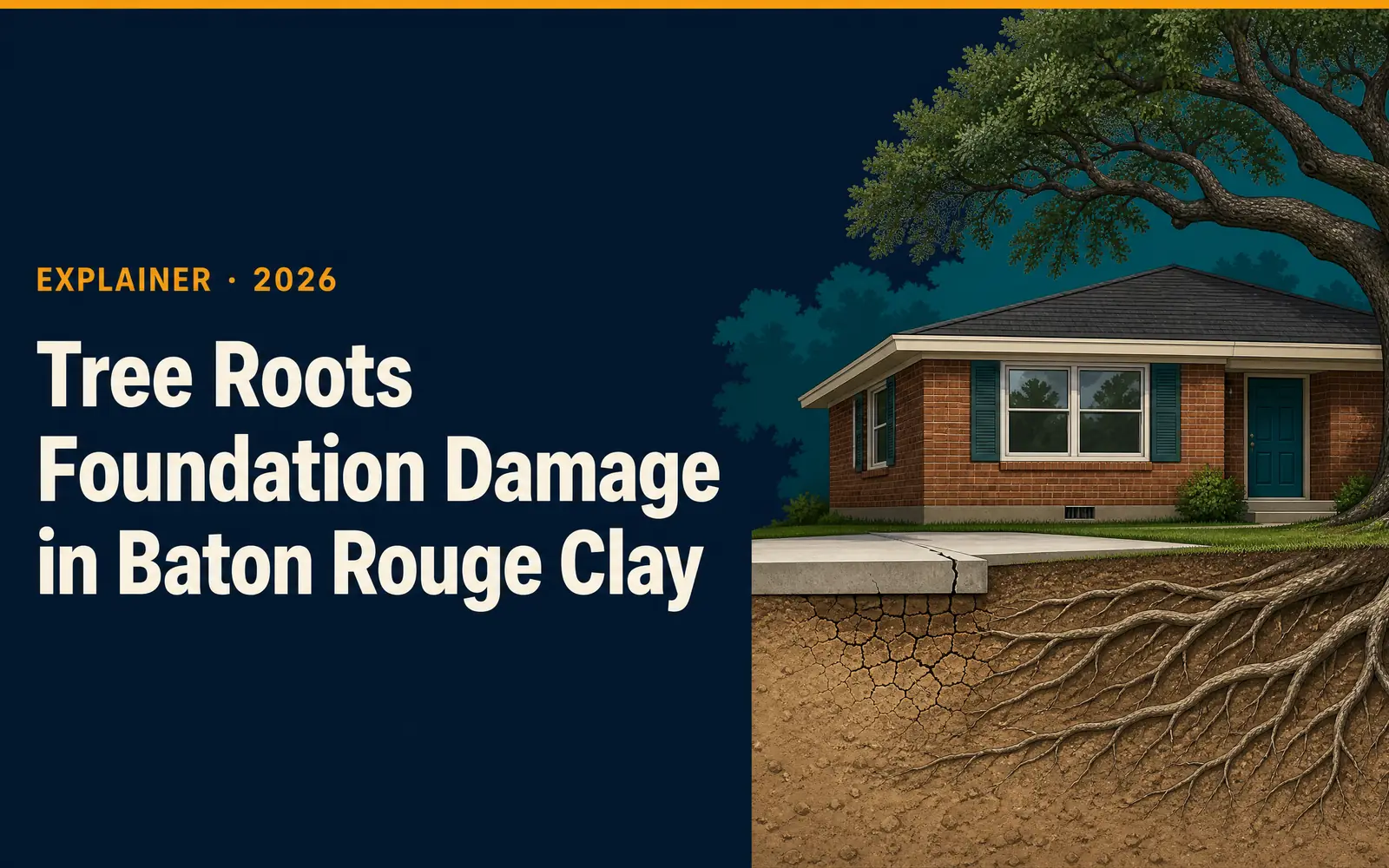
Can tree roots damage a foundation? Yes, but in Baton Rouge the usual cause of tree roots foundation damage is not a root pushing on concrete. It is the root system drying out the expansive clay under the slab edge, so that corner of the house shrinks down and cracks.
Key Takeaways
- Roots rarely break an intact slab. Purdue Extension's Lindsey Purcell says roots that hit foundations are usually "redirected laterally or up and over" — Purdue FNR Extension
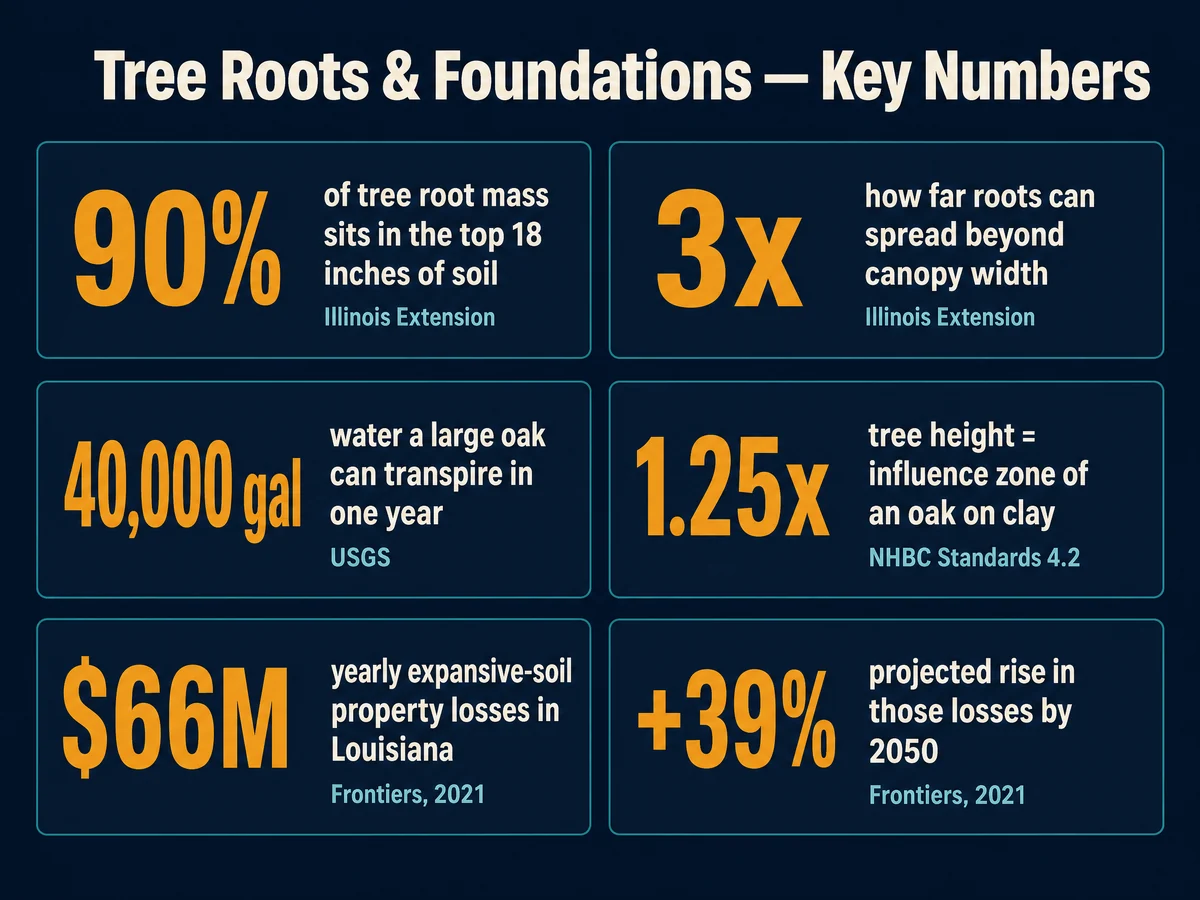
- Over 90% of tree root mass sits in the top 18 inches of soil, the same layer a slab edge rests on — University of Illinois Extension
- A large oak can transpire about 40,000 gallons of water a year, and much of it comes out of the clay around it — USGS Water Science School
- Expansive soil already costs Louisiana about $66 million a year in property losses, projected to reach about $92 million by 2050 — Frontiers in Built Environment, 2021
- For clay soils, the UK's NHBC method treats an oak's influence zone as 1.25 times its mature height
- Cutting down a big tree near the house can cause the opposite problem, heave, as the dried clay re-wets and swells
Can tree roots damage a house foundation directly?
Tree roots can damage a foundation directly, but only when the foundation gives them a way in. Roots grow where it is easy to grow: loose soil, mulch, and existing cracks or leaking joints that offer water.
Lindsey Purcell, urban forestry specialist at Purdue University, puts it plainly: “Tree roots can damage a house foundation, with an invitation to do so.” In the same Purdue Extension answer, Purcell notes that “when roots encounter solid, impervious surfaces such as pipes, sidewalks, curbs and foundations, they are redirected laterally or up and over.”
That matches what shows up around Baton Rouge homes. Lifted driveway panels and sidewalks near big oaks are common, because thin flatwork sits right in the root zone. A reinforced slab or a brick stem wall is a different story, and direct root breakage of an intact foundation is uncommon.
How do tree roots cause foundation damage in clay soil?
In clay, tree roots cause foundation damage mostly by removing water. Baton Rouge and the Capital Region sit on expansive clay that shrinks as it dries and swells as it wets, and a large tree is a powerful pump.
The USGS Water Science School estimates that a large oak can transpire 40,000 gallons of water a year. When roots reach under the edge of a slab, they pull moisture from that clay faster than rain replaces it. The soil loses volume, that section of the slab loses support, and the corner nearest the tree settles.
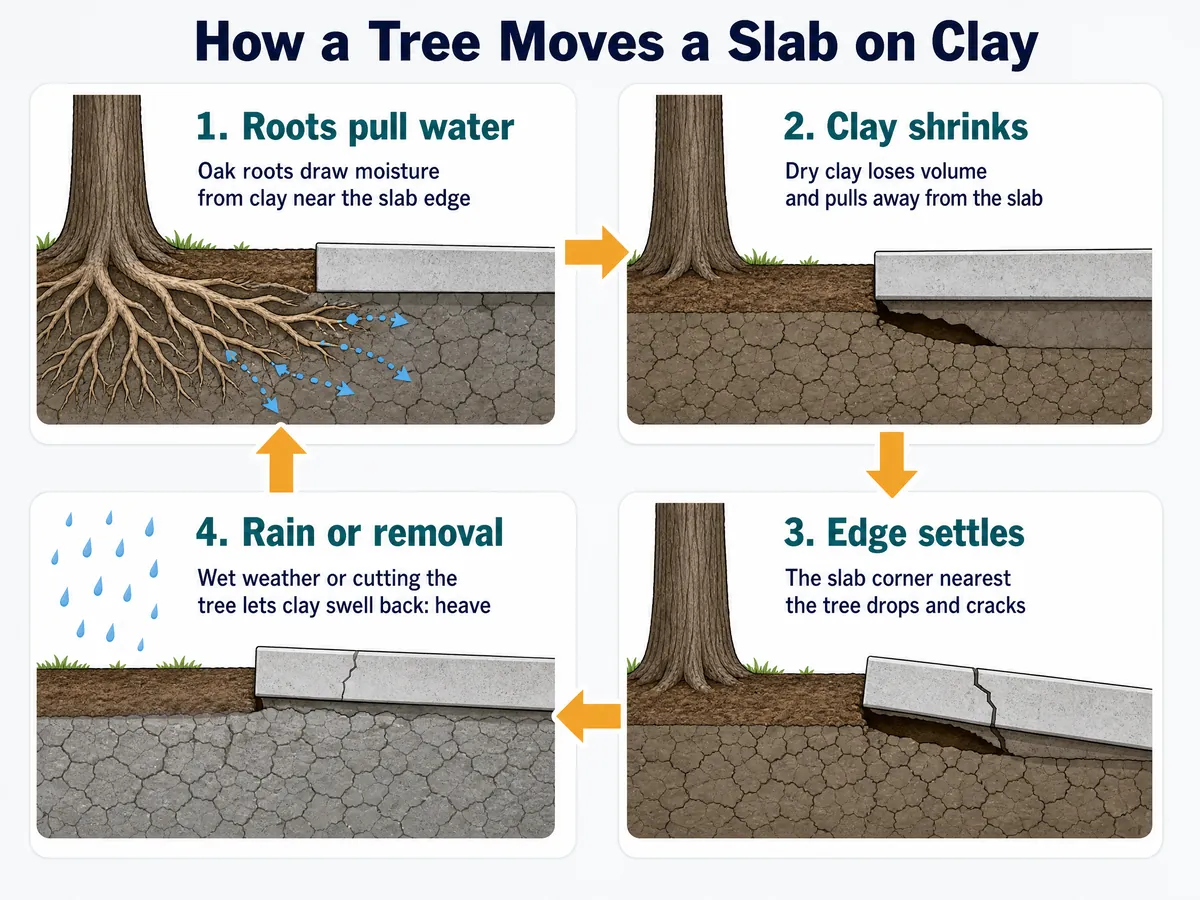
The UK’s house-building warranty body, NHBC, built its Chapter 4.2 building-near-trees standard around this effect: trees extract moisture, which increases shrinkage in dry periods and contributes to heave when moisture returns. U.S. building codes have no equivalent tree table, which is why that UK method is still the most useful reference for clay.
Why is tree root foundation damage worse in Baton Rouge?
Tree root foundation damage is worse here because three local factors stack up: very expansive clay, big high-water-demand trees, and long dry spells.
A 2021 LSU-led study in Frontiers in Built Environment put Louisiana’s average annual property loss from expansive soil at $66,231,136, rising 39% to $91,753,149 by 2050. The researchers found the heaviest losses concentrated around southern urban centers, with Baton Rouge named first.
The tree side matters too. Live oaks, water oaks and pecans are everywhere in older Baton Rouge neighborhoods, and oaks sit in the high-water-demand group in the NHBC method. Add a dry late summer like 2026’s, covered in our post on foundation cracks after drought, and the clay under a shaded slab corner can dry out far more than the rest of the house.
How far do tree roots reach toward a foundation?
Tree roots usually reach much farther than people expect, but they stay shallow. Ryan Pankau of University of Illinois Extension writes that “over 90% of tree root biomass occurs in the upper 18 inches of soil,” with root systems estimated at up to 3 times the canopy spread.
Clay trims that spread somewhat. Pankau adds that “heavy clay soils tend to support a smaller root structure, often only 0.5 times the canopy width.” Even so, Iowa State University Extension notes that structural roots “can reach a distance of more than four times the dripline of the tree.”
For foundation risk, the NHBC method is the practical yardstick. It sets a zone of influence equal to mature height times a water-demand factor: 0.5 for low, 0.75 for moderate and 1.25 for high-demand trees such as oaks, as summarized in this NHBC zone-of-influence explainer. The diagram below applies it to a 50-foot tree.
What are the signs of tree root foundation damage?
The signs of tree root foundation damage are ordinary settlement signs with one tell: they cluster on the side of the house closest to the tree. That pattern is what separates tree-driven movement from general house settling.
| Sign | Where to look | What it usually means |
|---|---|---|
| Diagonal cracks from door or window corners | Walls on the tree side | That corner of the slab is dropping |
| Stair-step cracks in brick veneer | Exterior brick nearest the tree | Differential settlement; see brick crack repair and how to read stair step cracks |
| Doors that stick or won’t latch | Rooms facing the tree | Frame racked by a low corner |
| Soil gap at the slab edge | Beds and lawn by the tree, in dry weather | Clay shrinking away as roots dry it |
| Lifted walk or driveway panels | Flatwork within the canopy | Direct root pressure on thin concrete |
| Sloping or bouncy floors | Raised homes, tree side | Piers settling in dried clay |
Our full signs of foundation problems guide covers each of these in more detail, and the crack-size guide tells you when a crack is worth a call.
Should you remove a tree that is damaging your foundation?
You should not remove a large tree near the house until the slab has been measured. On expansive clay, cutting down a mature tree can trigger heave: the dried soil under the slab re-wets over months or years and swells, lifting the section that had settled.
NHBC’s standard treats heave as a risk precisely because of this, and it is why a tree removal should be a planned decision. A laser elevation survey shows whether the tree-side corner is low and by how much. From there, the options are to remove or thin the tree with an arborist, install a root barrier, stabilize the slab, or combine them.
Purdue’s Purcell recommends cutting suspect roots and installing “a root barrier to prevent re-growth.” A barrier helps most when the house has not moved much yet. When the corner has already dropped, it will need support, usually pressed concrete pilings under the settled section as part of slab foundation repair.
How do you prevent tree roots foundation damage?
You prevent tree roots foundation damage by keeping the clay under the slab evenly moist and keeping big water users away from it. Moisture control does more than any single root trick.
- Plant new shade trees far from the slab. Use the NHBC idea as a guide: the bigger and thirstier the tree, the farther away it goes.
- Fix downspouts and grading. Water that runs away from the house on one side and pools on another makes uneven drying worse. Foundation drainage is usually the cheapest protection there is.
- Keep moisture steady in long dry spells. A soaker hose a foot or two from the slab helps. Our late-summer foundation check walks through the routine.
- Consider a root barrier between an established tree and the house, installed by someone who knows the tree’s root zone.
- Measure before and after big changes. Removing a tree, adding a pool or regrading the yard all change soil moisture.
Keep in mind that insurance will not usually pay for this kind of damage. Progressive’s coverage guide says it is the homeowner’s job to keep “tree roots from causing damage to the structure,” and gradual settlement is typically excluded.
What does tree root damage repair cost in Baton Rouge?
Repair cost depends on how far the tree-side corner has dropped and how many pilings it takes to support it. That is why the free evaluation from Foundation Repair Baton Rouge includes laser-measured readings and a written per-piling price, backed by 20 years of industry experience.
For current price ranges, see our foundation repair cost guide for Baton Rouge. For raised homes, pier and beam foundation repair follows a different process and pricing.
Big tree, cracks on that side of the house?
Book a free foundation evaluation. We measure the whole slab with a laser level so you know whether the tree side is actually lower before you decide anything about the tree.
Methodology. This explainer draws on primary sources only: Purdue, Illinois and Iowa State Extension publications, the USGS Water Science School, the 2021 LSU-led expansive-soil risk study (statewide losses modeled across Louisiana's parishes), NHBC Chapter 4.2 and an insurer's published coverage guidance. Search demand and the questions answered here come from a DataForSEO keyword, autocomplete and Google SERP pull for "tree roots foundation damage" in September 2026, where the top result was a Reddit r/arborists thread from home buyers worried about a tree beside a house. No customer stories, job counts or reviews are used. The NHBC figures are a UK standard, used here because no U.S. code gives tree distances for clay.