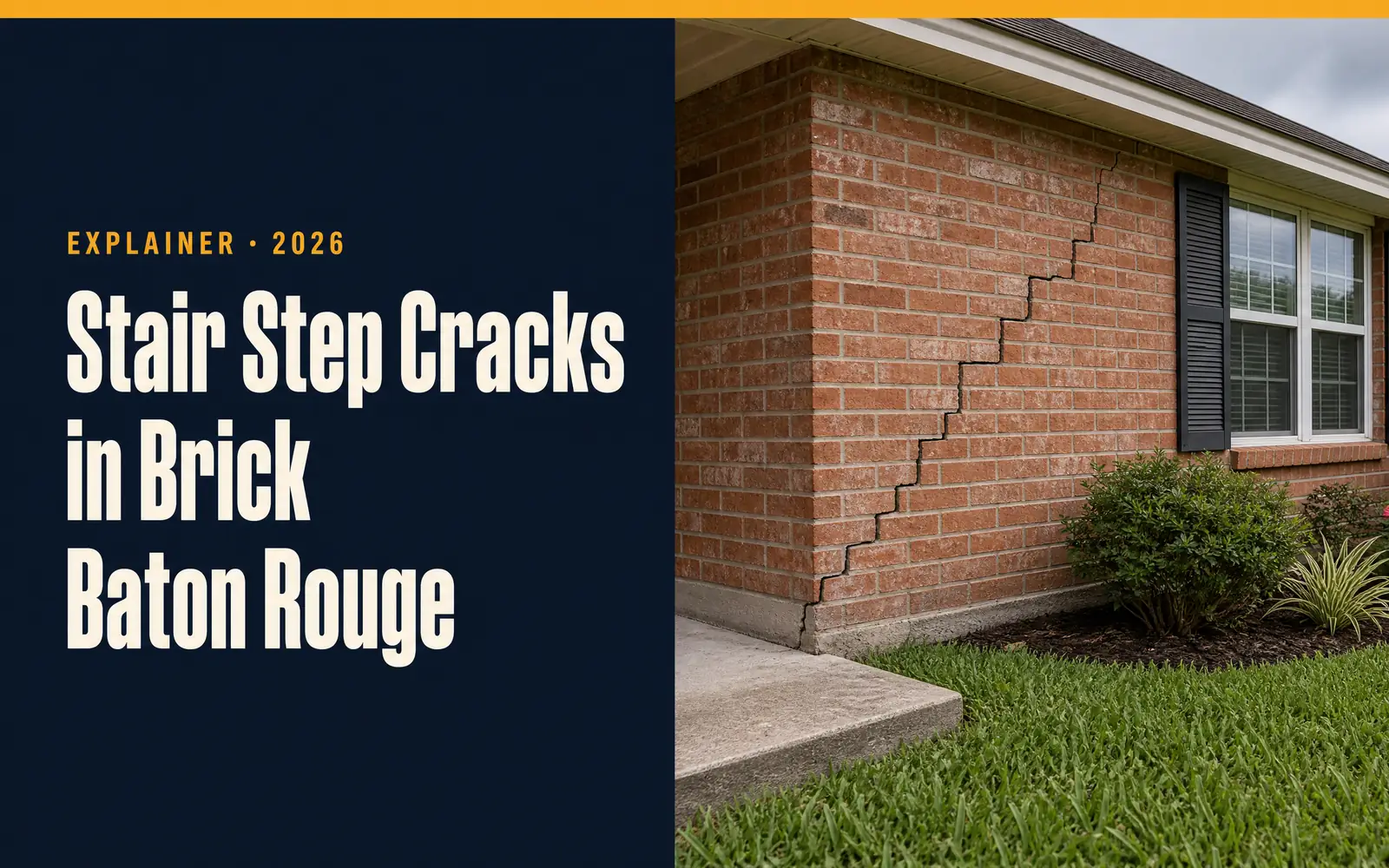
What do stair step cracks in brick mean on a Baton Rouge home? Usually that part of the slab edge under that wall has moved on shrink-swell clay. But brick expansion and sagging lintels make similar cracks. The shape tells you which: a crack that tapers, keeps growing or comes with sticking doors points to the foundation.
Key Takeaways
- "Unstable or expansive soils often cause movement or differential settlement," and settlement "may cause diagonal/stepped cracking" directly above the foundation — Brick Industry Association TN 18, 2019
- "Deflection and settlement cracks are identified by a tapering shape" — the same note. A crack of even width is more often brick expansion.
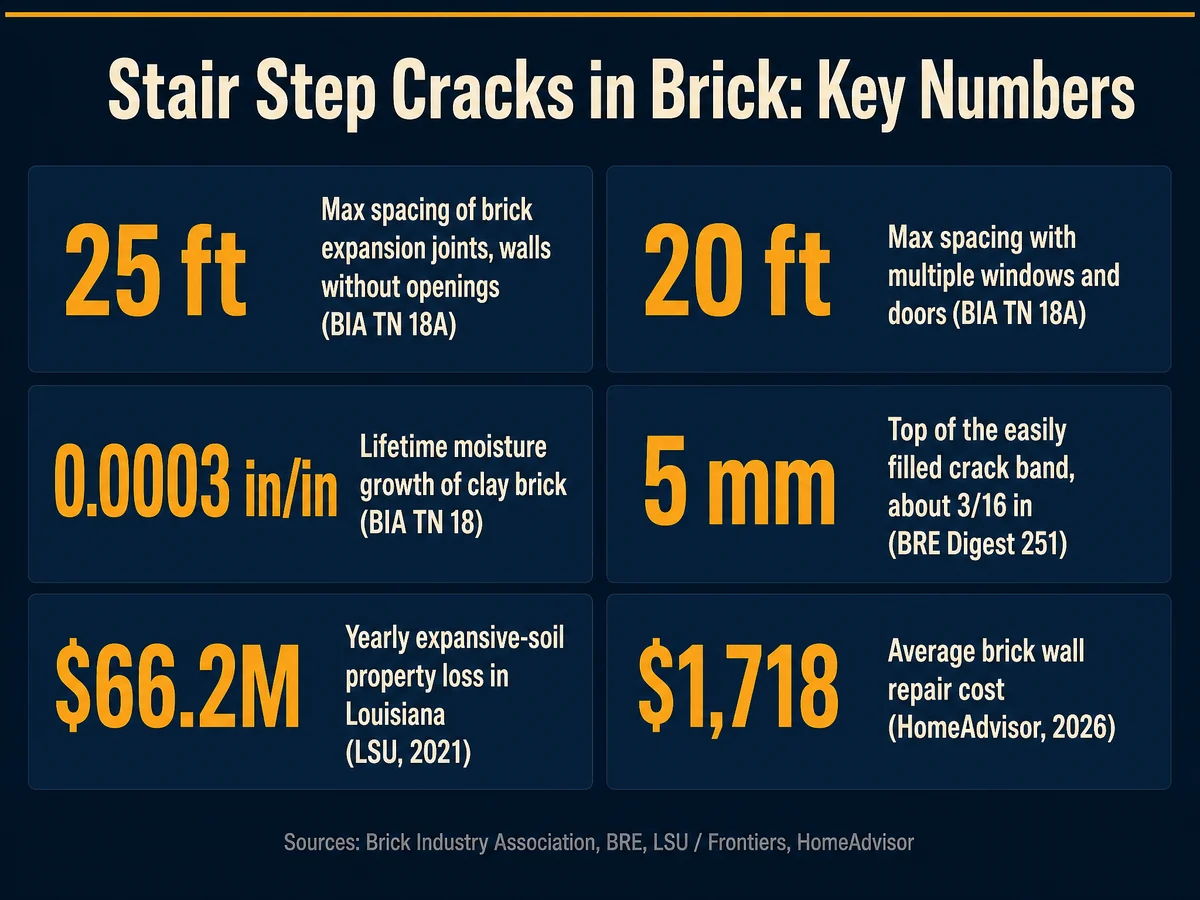
- Brick walls need expansion joints no more than 25 ft apart, or 20 ft with several openings — BIA TN 18A, 2019
- Cracks up to about 5 mm (3/16 in) are "easily filled"; 5 to 15 mm need a mason — BRE, from Digest 251
- Expansive soils cost Louisiana property owners an estimated $66.2 million a year — LSU and Eustis Engineering, 2021
- Brick wall repair averages $1,718, and mortar repair runs $10 to $20 per sq ft — HomeAdvisor, June 2026
What are stair step cracks in brick?
Stair step cracks in brick are cracks that zigzag diagonally through the mortar joints, one course at a time, so the line looks like a staircase. They follow the mortar because mortar is weaker than the brick. When a crack cuts straight through the bricks instead, the wall took a sharper or faster movement.
On most Baton Rouge ranch homes the brick is a veneer: a single layer of brick tied to a wood-frame wall and sitting on a ledge at the edge of the slab. It carries no load from the roof. It is stiff, though, and it can’t bend with the slab, so it shows movement before the drywall inside does. That’s why stair step cracks are on almost every list of signs of foundation problems.
Why do stair step cracks in brick happen?
Stair step cracks happen when part of the brick wall is pushed, pulled or left unsupported while the rest stays put. The Brick Industry Association’s technical note on movement lists the main causes, and three of them account for most cracks on houses.
- The foundation moved. “Unstable or expansive soils often cause movement or differential settlement in foundations that support brick masonry. Foundation settlement may cause diagonal/stepped cracking in the brickwork and mortar joints directly above the foundation” (BIA Technical Note 18, May 2019).
- The brick grew. Fired clay brick soaks up moisture from the air and expands for years, and that growth does not reverse. BIA’s design coefficient is 3 × 10⁻⁴ inches per inch. By our arithmetic, that’s about 1/10 inch over a 30-foot wall. Without an expansion joint, that growth cracks the wall at corners and between windows.
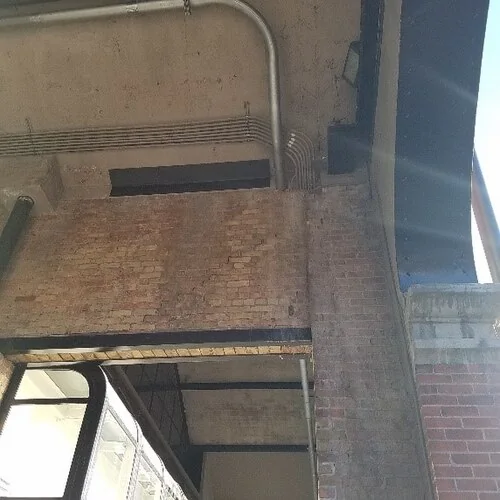
- A lintel sagged. The steel angle over a window or garage door carries the brick above it. BIA’s Photo 9 shows “a deflection crack caused by supporting brickwork on an undersized lintel. The crack is wider at the steel angle and tapers to nothing.” Rust makes it worse, because corroding steel expands and pushes on the brick.
Other causes are rarer: tree roots drying out the soil on one side of a house (see how tree roots damage foundations), slab curling, and a fault running under the lot.
What does Baton Rouge clay change about stair step cracks?
Baton Rouge clay makes the first cause, foundation movement, more common, and it makes it move both ways. The soil under a slab shrinks in a drought and swells after heavy rain, so a crack can open in October and partly close in March.
The USDA soil survey of East Baton Rouge Parish says much of the damage to foundations, roads and other structures here comes from soils shrinking and swelling as they wet and dry. It rates Sharkey clay, which “develops extensive shrinkage cracks as it dries”, and Tunica clay as high shrink-swell (Soil Survey of East Baton Rouge Parish, 1968). An LSU and Eustis Engineering team put Louisiana’s expansive-soil property losses at $66.2 million a year, concentrated in south Louisiana.
Brick veneer sits right on the slab edge, the part of the slab whose soil dries out and wets up fastest. When one corner drops, the brick above it shears along the mortar. Wet clay doesn’t stop the cracking, either. It can lift a perimeter beam and open a crack that tapers the other way. This fall matters. East Baton Rouge Parish went back into severe drought in late September 2026, and drought cracks usually show at corners first.
Faults are the local wild card. The Louisiana Geological Survey’s 1981 door-to-door damage study found that along the Baton Rouge and Scotlandville–Denham Springs faults, brick cracks usually slope northward at about 45 degrees as the south part of the building drops. Investigators also checked damage in College Park and judged it not fault-related, more likely caused by groundwater swings and local soils (LGS and Durham Geological Associates, 1981). Our Baton Rouge fault guide explains how to check a lot against the fault map.
How do you tell a foundation crack from a brick crack?
You tell them apart by the shape, the location and what else is happening in the house. BIA puts it simply: “The shape, location and magnitude of cracking will often indicate the cause.” Use this table as a first sort, not a diagnosis, and see our guide to the types of foundation cracks for the slab-side patterns.
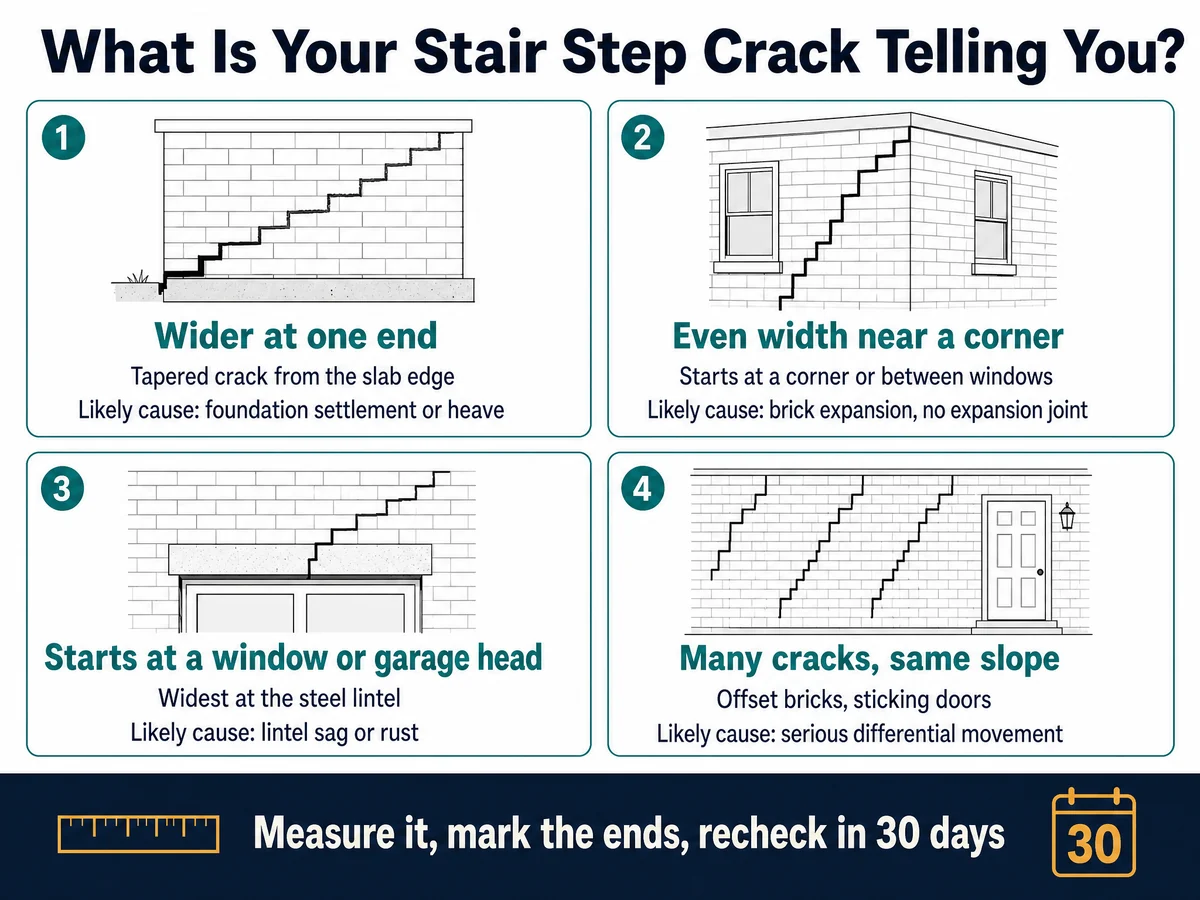
| What you see | Most likely cause | What it points to |
|---|---|---|
| Crack wider at one end, starting low near the slab corner | Settlement (wider at top) or heave (wider at bottom) | Foundation movement; get the floor measured |
| Even-width crack near a corner, or vertical crack a few bricks from a corner | Brick expansion with no expansion joint (BIA TN 18) | Masonry detail, usually not the slab |
| Diagonal crack between two windows or doors | Brick expansion, or settlement if it tapers | Check for taper and sticking windows |
| Crack starting at the corner of a window or garage door head, widest at the steel | Lintel deflection or rust (BIA TN 18, Photo 9) | Lintel repair, not foundation repair |
| Several cracks sloping the same way, bricks offset, rooflines warped | Major differential movement or a fault (LGS, 1981) | Engineer evaluation |
| Cracks plus sticking doors, drywall cracks at door corners, sloping floors | Slab movement | Foundation inspection |
Inspectors tend to agree that the staircase shape matters less than the taper. In an often-cited Inspector’s Journal thread (2011), one inspector argued that the useful questions are whether the wall is still in one plane and whether the crack’s width changes from end to end. The same thread shows why a forum can’t settle it: the buyer had already hired foundation contractors and structural engineers.
When should you worry about stair step cracks in brick?
Worry when the crack is wide, tapered, growing, or part of a pattern. A single hairline stair step crack with nothing else going on is common and usually cosmetic. One that meets two or more of the points below needs a measured inspection.
The British BRE damage scale, from BRE Digest 251, is the most widely used way to grade crack width. On BRE’s own summary (Assessing cracks in houses):
| BRE category | Typical crack width | What BRE says |
|---|---|---|
| 0 | Under about 0.1 mm (hairline) | “Classed as negligible”; no action |
| 1 | Up to 1 mm (about 1/32 in) | “Cracks rarely visible in external brickwork” |
| 2 | Up to 5 mm (about 3/16 in) | “Some external repointing may be required” |
| 3 | 5 to 15 mm (3/16 to 5/8 in), or several of about 3 mm | Repointing and “possibly a small amount of brickwork to be replaced” |
| 4 | 15 to 25 mm (5/8 to 1 in) | “Breaking-out and replacing sections of walls, especially over doors and windows” |
| 5 | Over 25 mm (1 in) | “A major repair job, involving partial or complete rebuilding” |
BRE groups categories 0 to 2, cracks up to 5 mm, as “aesthetic” issues, 3 and 4 as “serviceability” issues and 5 as “stability” issues. Width isn’t everything, though. Add these warning signs:
- Taper. BIA: settlement and deflection cracks “are identified by a tapering shape.” A crack wider at the top usually means the corner dropped. Wider at the bottom usually means heave.
- Growth. A crack that has widened since you last looked is still moving.
- Offset. Bricks on one side of the crack sit in front of or below the bricks on the other side.
- Matching inside signs. Doors that stick, diagonal drywall cracks at door corners, or gaps at window frames on the same wall.
- Doors and trim. The Foundation Performance Association’s homebuyers’ guide tells buyers to record each brick crack’s length, width and location, note whether it’s wider at the top or bottom, and look for mortar patches, which show up when the wall is wet.
Our guide to how big is too big for a foundation crack covers slab cracks, and house settling vs foundation problems explains what normal movement looks like.
How do you check a stair step crack yourself?
You check it by measuring it, marking it and coming back. One look tells you how big the crack is. Two looks a month apart tell you whether it’s still moving, and that matters more.
- Photograph it with a tape measure or a coin in the shot, so the scale is clear.
- Measure the width at both ends and in the middle. A feeler gauge or a crack-width card works; the FPA guide says coins, a credit card or a thumbnail give a rough estimate.
- Mark the ends with a fine pencil line and the date. If the crack runs past the marks later, it’s growing.
- Check the rest of that corner. Open and close the nearest doors and windows, look at the drywall inside the same wall, and see where the downspouts drain.
- Recheck in 30 days and again after the next long dry spell or heavy rain. On Baton Rouge clay, a crack that opens in drought and closes after rain means the soil under that corner is moving with the seasons.
If the crack is wider than about 3/16 inch, tapers, or comes with sticking doors, skip the waiting and book a free foundation evaluation. Our online foundation damage assessment can help you sort the signs before anyone visits. Our step-by-step guide to fixing foundation cracks shows how to log slab cracks the same way.
What have Gulf South homeowners seen with stair step cracks in brick?
Local stories follow the same pattern: brick cracks show up first, and the outcome depends on whether anyone measured the house.
- A Baton Rouge inspector on lintel cracks. On the InterNACHI forum in 2004, Baton Rouge home inspector Alan Fernbaugh described 45-degree cracks over openings, “usually in the joints”, that can show up “very soon after the brick work is completed as the brick adds to the loads of the lentil.” Another inspector in the thread said cracks under 1/4 inch that aren’t V-shaped or rotated are usually fine.
- A Baton Rouge slab home with brick cracks and a fireplace pulling away. A TigerDroppings poster (2021) saw brick cracks above the front door and on an exterior wall, a gap near a window and a firebox separating from the fireplace. The floors looked fine, but the house had floating vinyl plank flooring, which can hide slab cracks.
- The 2023 drought. On a November 2023 TigerDroppings thread, one poster said a neighbor had “about a 3 inch wide gap in the bricks” around the back door, where the worst slab cracks were, and daylight showing around the closed door. A Baton Rouge poster in the same thread blamed expansive clay contracting in the drought.
- A Katy, Texas buyer. A buyer looking at an 8-year-old brick house on similar Gulf Coast clay found several stair step cracks about 1/8 inch wide or less on two sides, with no inside cracks (City-Data, 2016). Replies said to get a structural engineer before buying.
If you’re buying, our guide to buying a house with foundation repair covers what to ask for. In a newer home, new construction foundation cracks explains what the builder’s warranty usually covers.
How much does it cost to fix stair step cracks in brick?
The brick repair is usually the cheap part. Repointing a cracked section costs hundreds to a few thousand dollars. If the slab under it is moving, the foundation repair comes first and costs more.
| Item | Published cost | Source |
|---|---|---|
| Brick wall repair, average | $1,718 (most pay $804–$2,640) | HomeAdvisor, June 2026 |
| Mortar repair | $10–$20 per sq ft | HomeAdvisor, June 2026 |
| Brick wall cracks (cost table) | $500–$1,000 | HomeAdvisor, June 2026 |
| Tuckpointing, national average | $1,500 (range $500–$2,500) | Bob Vila, updated Dec 2023 |
| Foundation repair under the wall | See local pricing | Foundation repair cost in Baton Rouge |
Order matters more than price. Repoint a wall whose corner is still dropping and the crack comes back, usually in the new mortar. Stabilise first, often with pressed concrete pilings under that section of the beam, then repair the brick. Our brick crack repair page covers the masonry side, and slab foundation repair covers the structural fix.
Our take: what I’d do about stair step cracks in brick
Opinion and analysis by Jonathan Dyer, based on the sources above.
In industrial concrete and steel repair, you never patch a crack until you know why it opened. A crack is a symptom, and filling a live one only hides the next movement. Brick veneer is the same, and in some ways it’s more honest than concrete, because it shows movement early and in a shape you can read.
So here’s what I’d do. First, I’d look at the shape before the width. An even-width crack near a corner or a crack starting at a garage door head usually means a masonry fix: an expansion joint or a new lintel. Next, if the crack tapers from the slab corner, I’d mark it and check it through a dry month and a wet one. On Baton Rouge clay, that one comparison tells you more than any single visit.
Then I’d fix the water around that corner. Downspouts dumping at the slab and beds that stay soaked do more harm than most homeowners think, so I’d start with foundation drainage. And I wouldn’t repoint anything until the floor has been measured and the corner is stable. Caulk on a moving crack is a patch over a question nobody has answered.
What goes wrong when people fix stair step cracks in brick?
Most failed repairs come from treating the brick and ignoring the cause:
- Repointing a live crack. New mortar cracks again along the same line, and the old crack’s width history is gone.
- Smearing caulk over the face. It traps water in the joint and looks worse than the crack. Use it only as a temporary seal, if at all.
- Using hard mortar. Mortar stronger than the original makes the brick, not the joint, take the next crack.
- Ignoring the lintel. A rusted steel angle keeps expanding. The crack over the garage returns until the lintel is cleaned and coated or replaced.
- Skipping the drainage. Water at the slab edge keeps moving the soil, whatever you do to the brick.
- Not checking the floor. A brick crack without a floor-elevation survey is one puzzle piece. A laser survey shows whether that corner is low.
Methodology. This explainer is built from published sources, not a customer project: Brick Industry Association Technical Notes 18 and 18A (May 2019), BRE's summary of Digest 251, the USDA soil survey of East Baton Rouge Parish, the LSU and Eustis Engineering expansive-soil loss study (2021), the Louisiana Geological Survey's 1981 fault damage study, the Foundation Performance Association homebuyers' guide, and 2023–2026 cost guides from HomeAdvisor and Bob Vila. The 1/10-inch figure is our own arithmetic using BIA's moisture expansion coefficient. Search demand was checked with DataForSEO in October 2026: "stair step cracks" gets about 320 U.S. searches a month and "stair step cracks in brick" about 140, both with keyword difficulty 0. The top Baton Rouge results were forums and out-of-state contractors. Homeowner and inspector experiences are paraphrased from public forum posts and linked to their sources. Reddit could not be reached during research, so no Reddit posts are used. No customer stories, quotes or jobs are invented. The hero, chart and stats images are AI-generated illustrations; the crack photo is a licensed Wikimedia Commons image.
Found a stair step crack?
Book a free evaluation. We look at the crack pattern, take laser readings across the floor, and tell you whether it's a brick repair or a foundation repair, with a written price. Request a free evaluation or read more about brick crack repair in Baton Rouge.