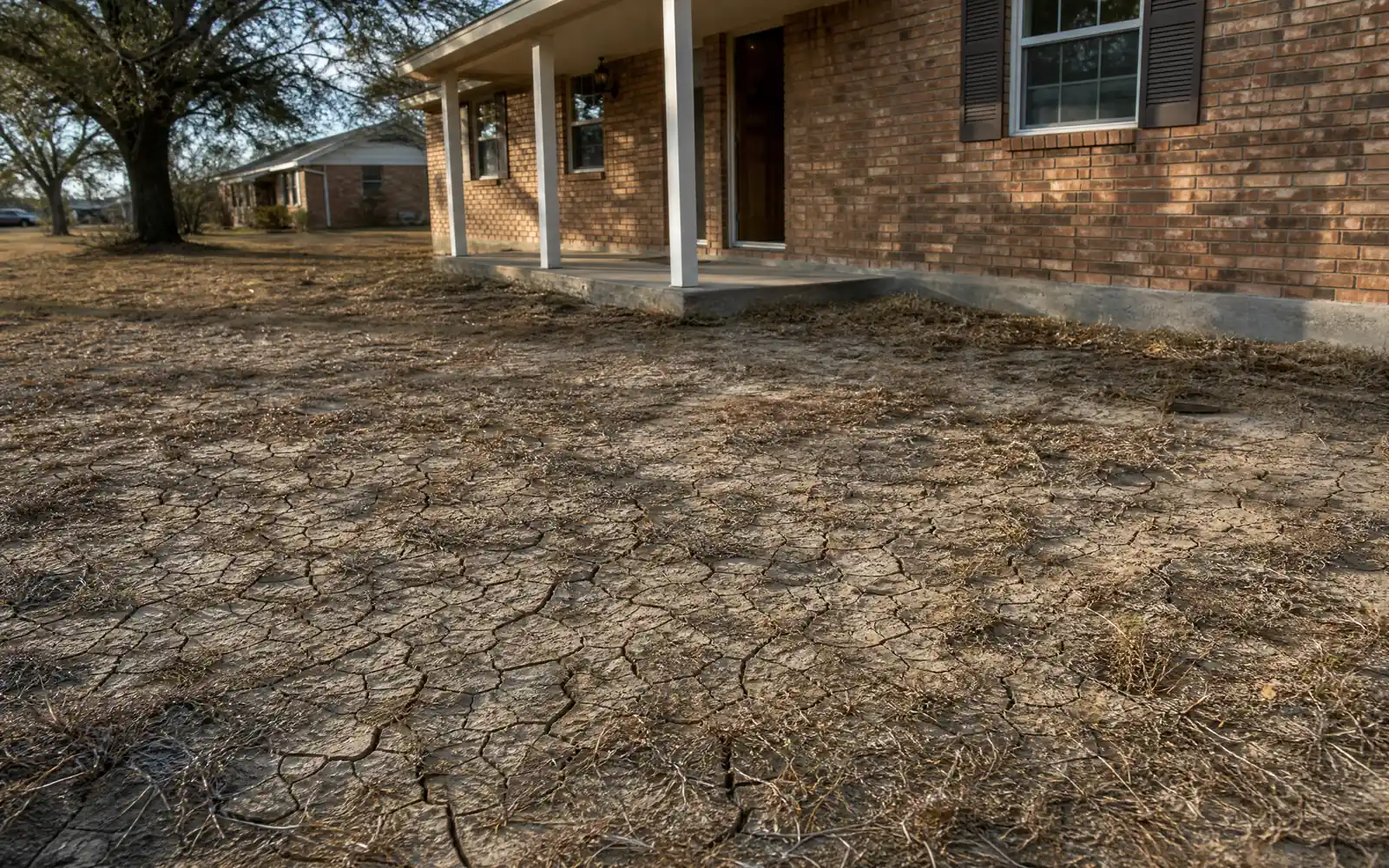
Foundation Repair Baton Rouge has been fielding more calls than usual this month, and the U.S. Drought Monitor explains why. As of September 15, 2026, roughly 80% of Louisiana was in moderate to severe drought, after NOAA’s drought program ranked this state’s 11th-driest August on record. Foundation cracks after drought are one of the most common calls we get once soil this dry finally gets real rain, and this stretch is setting up exactly that.
Update, October 23, 2026: the drought has deepened
Since this post was first written, conditions have worsened. The U.S. Drought Monitor map valid October 20, 2026 puts 88.6% of Louisiana in drought (D1 to D4), including 39.0% in extreme drought and 2.2% in exceptional drought, up from about 80% in mid-September. Drought.gov counts about 3.5 million Louisiana residents in drought areas, a 10% jump in one week, and says September 2026 was the state’s 16th-driest September since 1895, with 2.02 inches of rain, 2.10 inches below normal.
The Baton Rouge outlook is dry too. WAFB’s October 20 forecast said the Weather Prediction Center outlook keeps the area dry for seven days with no sign of rain into the last week of October. For homeowners, that means the soil is still drying and shrinking, so the cracks opening now are the baseline to measure against when the rain does return. If you have not yet photographed cracks or watered the soil evenly, do it this week.
Key takeaways
- About 80% of Louisiana was in drought as of September 15, 2026, and 88.6% as of October 20, per the U.S. Drought Monitor via Drought.gov.
- Baton Rouge sits on expansive clay that shrinks when dry and swells when wet — the region’s leading cause of foundation movement, per LSU AgCenter research.
- Cracks that open during drought often widen, not close, once heavy rain returns and soil rehydrates unevenly.
- A hairline crack is usually cosmetic; one you can see daylight through, or one paired with sticking doors, is worth a professional look.
- The best time for a free evaluation is before the next big rain, while movement is easiest and cheapest to address.
Why is Louisiana in a drought right now?
Louisiana’s summer of 2026 ran well below normal rainfall, and the deficit compounded through August. Drought.gov, the federal drought-tracking service run by NOAA’s NIDIS program, put close to 2.8 million Louisiana residents in a drought-affected area as of mid-September, with January–August ranking as the state’s 52nd-driest stretch since 1895. Conditions are easing slightly, but the ground under most Baton Rouge homes is still far drier than in spring.
Why does dry soil crack a foundation?
Baton Rouge and the surrounding parishes sit on expansive clay. According to LSU AgCenter’s soil research, this clay contracts as it dries and expands again when it absorbs water, and that shrink-swell cycle is the single biggest driver of foundation problems in the region. During a drought, clay under and around a slab shrinks away, leaving gaps that let an edge of the foundation drop slightly. That’s why dry spells like this one are when cracks, sticking doors and baseboard gaps tend to show up first.
What happens when the rain finally returns?
This is the part homeowners don’t expect: the risk doesn’t end when the drought breaks. Clay rarely rehydrates evenly — the perimeter, closest to gutters, downspouts and sloped grading, often absorbs water faster than soil under the slab’s center. That uneven swelling can push cracks wider instead of closing them, which is why foundation repair calls spike in the weeks after a long dry spell finally breaks, not just during it. NOAA’s October 2026 outlook suggests that test is coming soon; here’s what El Niño rain means for drought-dry Baton Rouge foundations.
How can you tell normal cracks from a real problem?
Most homes get some hairline cracking in stucco, brick mortar or slab joints during a drought like this one — normal seasonal movement. Our guide to the signs of foundation problems covers this in more detail; a few signs are worth calling about specifically:
- A crack wide enough to see daylight through, or that you can fit a nickel into
- A stair-step crack in brick or block that keeps growing (here is how to read stair step cracks in brick)
- Doors or windows that stick in a pattern (all upstairs, all on one side of the house)
- A visible gap or slope where the slab meets the foundation wall
What should you do before the rain comes back?
A few things help, whether or not you’re seeing cracks yet:
- Keep soil around the slab evenly moist, not soaked, with a soaker hose during dry stretches — gradual watering beats a sudden downpour rehydrating it all at once. Here’s how to water your foundation in a Baton Rouge drought without overdoing it. It matters most on the side nearest a big oak, where tree roots dry out the clay under the slab edge.
- Check that grading still slopes away from the house. Dry soil settles and can flatten grading; our foundation drainage team can correct it before the wet season hits.
- Photograph any cracks now, with a coin for scale, as a before picture in case they change once it rains. Hold off on sealing them until you’ve watched them for a while; our foundation crack repair how-to explains why.
- Get a baseline reading. A foundation inspection with laser-measured elevation gives you a reference point for after the next big rain.
If cracks are already wide enough to notice, our foundation crack repair team can tell you whether it’s cosmetic or structural before the rehydration cycle makes it worse.
How do you measure whether a crack is moving?
A crack that is moving matters more than one that is merely there. Mark both ends of the crack with a pencil and date them, measure the width at the widest point with a crack gauge or a ruler, and photograph it with a coin for scale. Repeat every two weeks through the rehydration period. A crack that grows between measurements, or a gap that changes with the weather, is the one to bring to a professional. A laser elevation survey then shows whether the slab itself has moved or only the finish material. For repair options, see how to fix foundation cracks, and how big is too big for a foundation crack.
FAQ
Does drought really cause foundation damage?
Yes. Drought doesn’t damage a foundation directly, but the soil shrinkage it causes removes support from under a slab or pier-and-beam foundation, which can lead to settling, cracking and sticking doors — especially in expansive clay like Baton Rouge’s.
How long does it take for a drought-stressed foundation to show cracks?
It depends on how deep and how long the dry spell runs. A short dry stretch of a few weeks rarely shows up in the structure. A summer-long drought like 2026’s is long enough that many homes will show at least hairline movement.
Will heavy rain after a drought make cracks worse?
It can. Because clay rehydrates unevenly, the first heavy rains after a long drought are often when existing cracks widen rather than close, so this fall is worth watching closely. The U.S. Drought Monitor map for October 20, 2026 showed the drought still deepening, which sets up the same pattern once the rain returns.
Is drought-related foundation damage covered by homeowners insurance?
Usually not on its own — most standard policies treat gradual earth movement as excluded. Coverage varies by carrier, so check your specific policy or ask your agent.
If you’re seeing cracks, sticking doors, or gaps that showed up this dry season, contact us for a free evaluation with laser-measured readings before the rain comes back.
Sources: Drought.gov, Louisiana drought conditions (U.S. Drought Monitor, valid October 20, 2026); WAFB, "Cool mornings, warm afternoons and no rain in sight" (October 20, 2026); LSU AgCenter soil research.