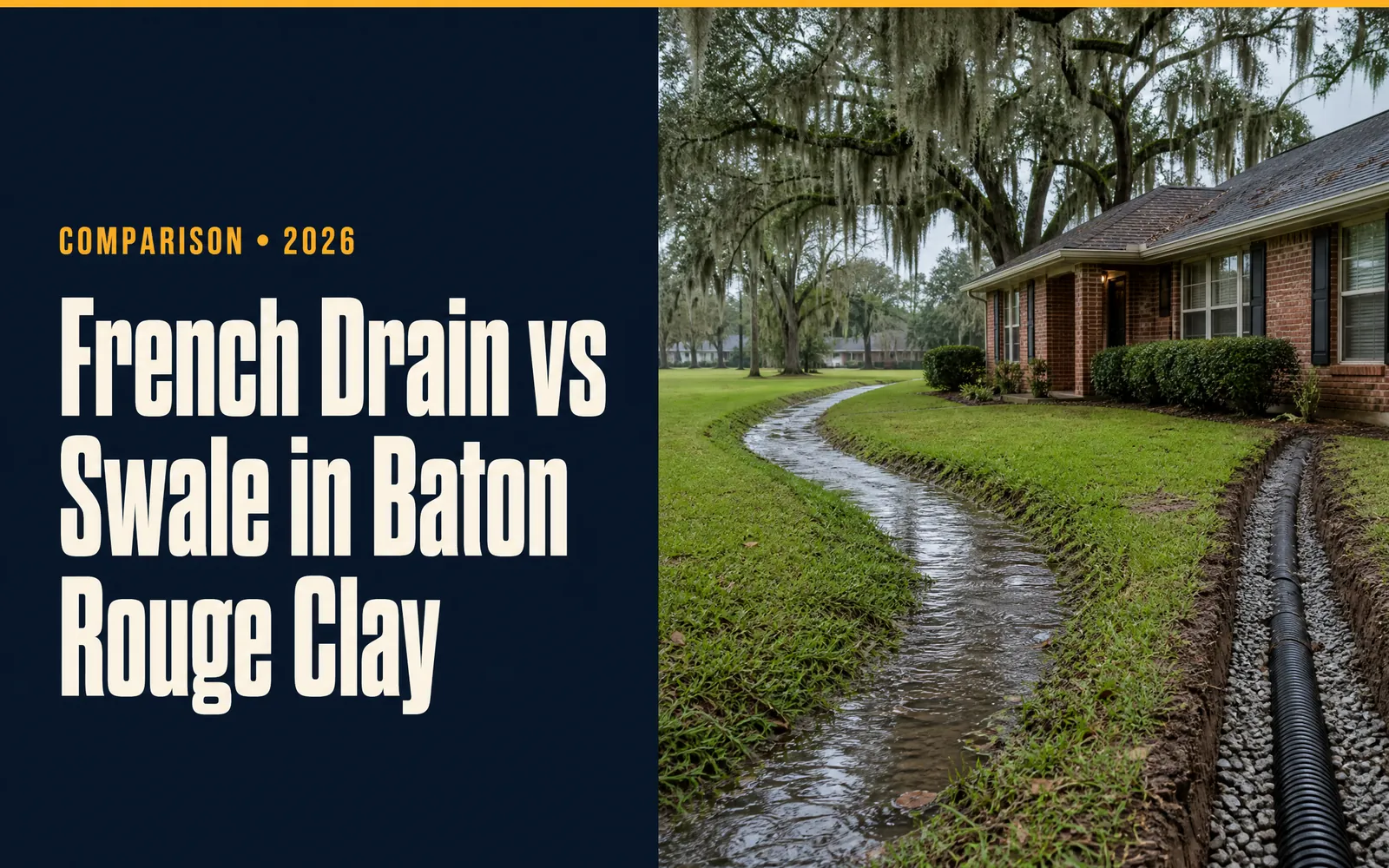
French drain vs swale: which works in Baton Rouge clay? A swale is a shallow grass channel that moves rain across the surface; a French drain is a buried gravel-and-pipe trench that collects water seeping through the soil. For runoff toward a slab, start with a swale. On flat, poorly drained lots, use both.
Key Takeaways
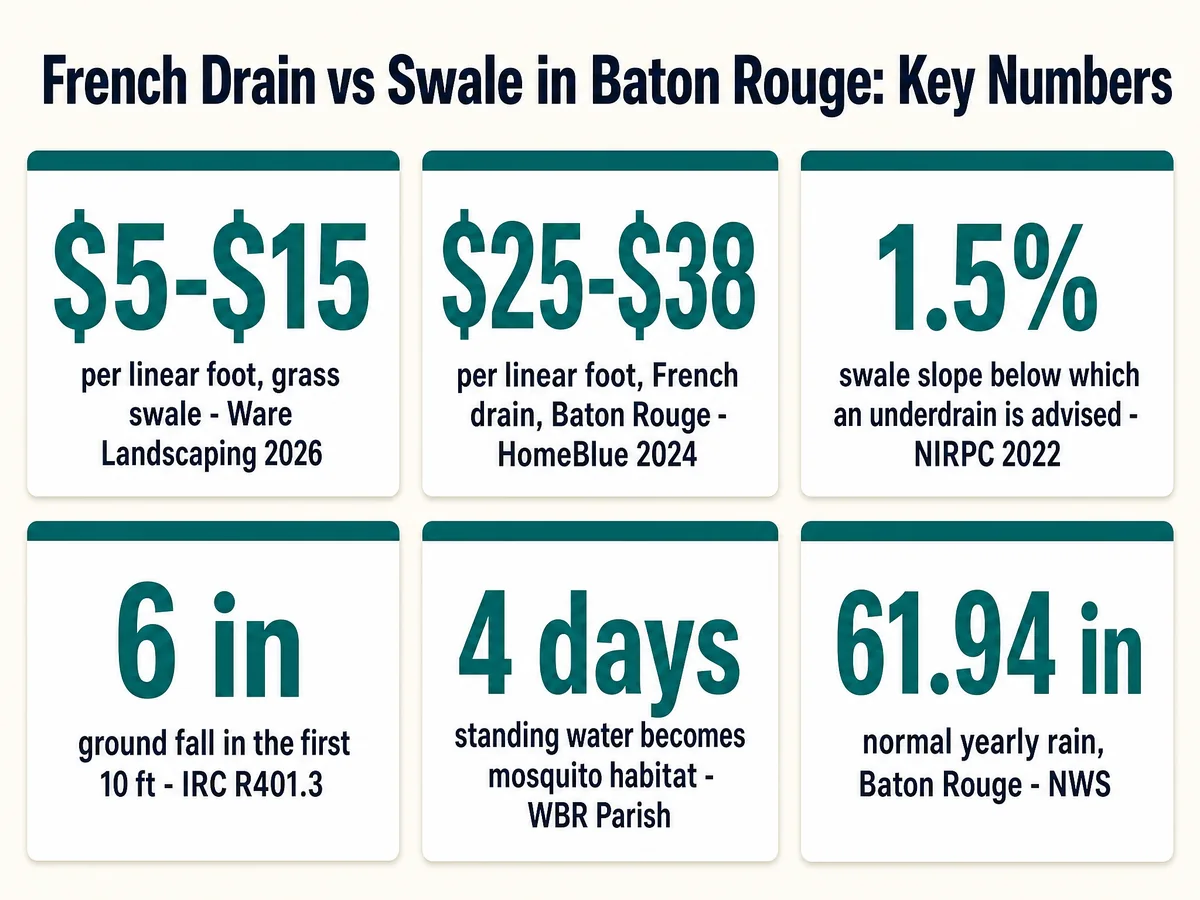
- Grass swales run about $5–$15 per linear foot ($2,000–$7,000 installed), against $20–$35 per foot for a standard exterior French drain — Ware Landscaping, 2026
- French drains in Baton Rouge cost $25–$38 per linear foot, about $1,470–$2,300 for 60 feet — HomeBlue, May 2024
- Calhoun soils, typed in East Baton Rouge Parish, are "poorly drained" with "very slow internal drainage" and slopes of 0 to 1 percent — USDA NRCS soil series
- Swales should get an underdrain when their slope is under 1.5% or the soil is poorly drained (hydrologic group C or D) — NIRPC Green Infrastructure Guidelines, 2022
- Surface water belongs in open grading or solid pipe; perforated drains are "appropriate to control subsurface water" — ASCE Texas Section, 2022
- Standing water near a home becomes a mosquito breeding ground in "usually about 4 days or more" — West Baton Rouge Parish
What is a swale?
A swale is a shallow, sloped channel shaped into the ground and covered in grass. Rain that would otherwise sheet across the yard toward the house drops into the swale and runs along it to an outlet: the street, a ditch, a catch basin or a low corner of the lot.
There is no pipe and no gravel. The work is all in the shape. North Carolina’s stormwater manual, which sets the rules for engineered treatment swales, keeps grassed side slopes “no steeper than 3:1” and the length-wise slope at or under 7%, with flow depth of 6 inches or less in its design storm (NCDEQ Stormwater BMP Manual, C-11). A yard swale is smaller and gentler. Ware Landscaping, a Chicago-area contractor that works on clay, recommends a grade of about 1 to 2% (Ware Landscaping, 2026).
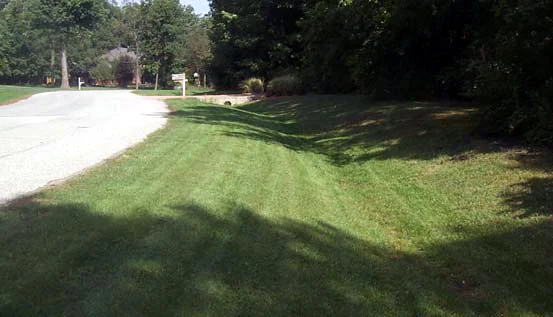
Louisiana’s residential code already expects something like this around every house. IRC R401.3 asks for the ground to fall at least 6 inches in the first 10 feet from the foundation and, where a lot line or wall blocks that, allows a 5% slope to “drains or swales” (InterNACHI summary of IRC R401.3). In practice, a side-yard swale between two Baton Rouge houses is often how a lot meets that rule.
What is a French drain?
A French drain is a trench lined with filter fabric, filled with washed gravel and usually fitted with a perforated pipe. Water that moves through the soil finds the gravel, drops into the pipe and runs downhill to an outlet. It is a subsurface drain.
The ASCE Texas Section’s residential foundation repair guidelines draw the line clearly. “Subsurface water drains are appropriate to control subsurface water, and usually consist of perforated pipe, with or without filter fabric, in an aggregate-filled trench,” with a continuous slope of 2% where practicable and 1% at minimum. For surface water, the same guidelines call for solid pipe, and they add: “Downspouts and surface drains should not be connected to perforated pipe subsurface drainage systems” (ASCE Texas Section, Version 3, 2022).
We’ve covered the build itself step by step in how to install a French drain in Baton Rouge clay. This article is about whether you need one at all.
How does a French drain compare to a swale in Baton Rouge?
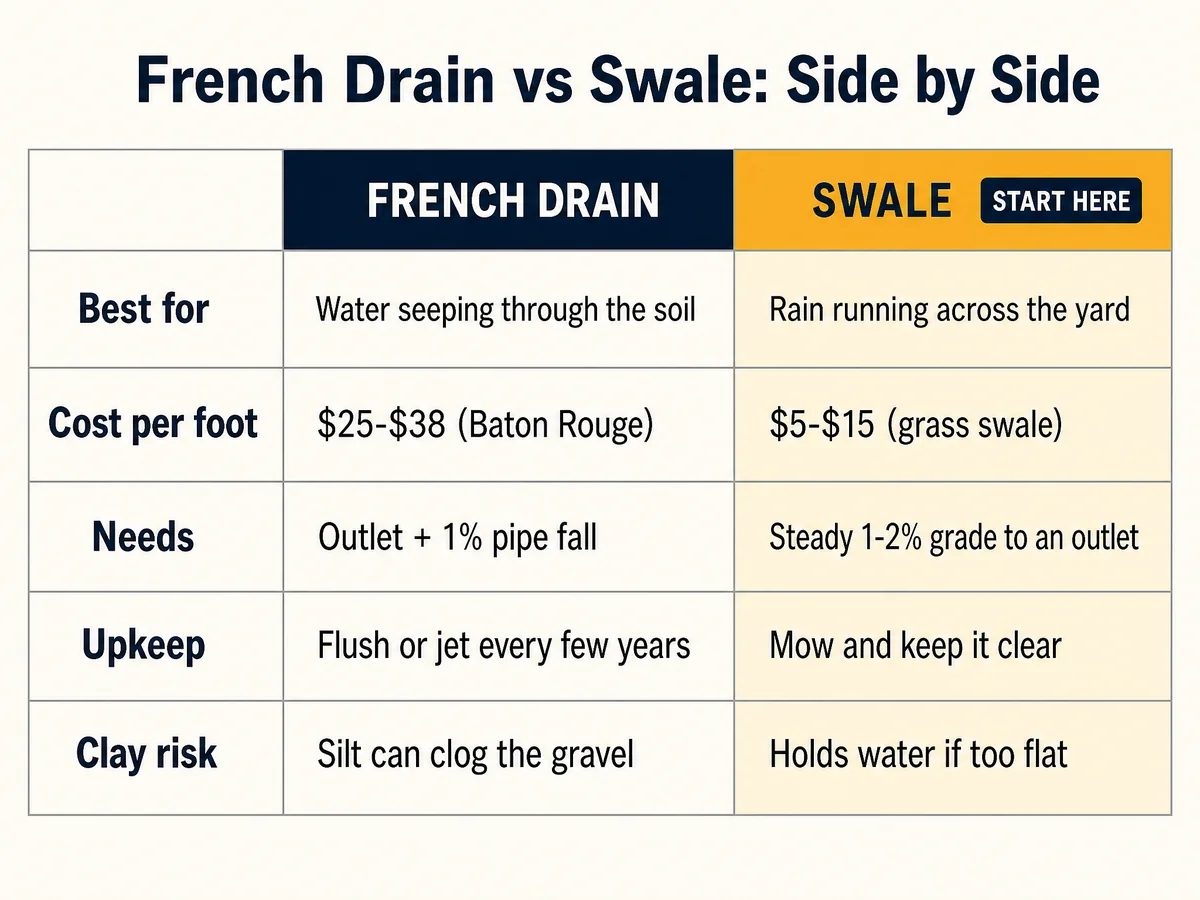
A swale wins on cost, simplicity and upkeep for surface runoff. A French drain wins when water is moving underground, when there is no room to shape a channel, or when the yard is too flat for open flow. Here is the side-by-side:
| Factor | French drain | Swale |
|---|---|---|
| What it handles | Water seeping through the soil | Rain running across the surface |
| Where the water goes | Into gravel and a perforated pipe, underground | Along an open grass channel |
| Typical cost | $25–$38 per ft in Baton Rouge; $20–$35 per ft standard exterior nationally | $5–$15 per ft (grass); $20–$45 per ft (planted bio-swale) |
| Slope needed | 1% minimum, 2% preferred, on the pipe | About 1–2% along the channel; no flat spots |
| Outlet | Required: daylight, street, catch basin or dry well | Required: street, ditch, catch basin or low area |
| Space | A narrow trench, can run close to beds and walks | Several feet wide with gentle side slopes |
| Upkeep | Cleanout, flushing or jetting every few years | Mowing, clearing debris, regrading low spots |
| Main clay risk | Silt and roots clog the gravel or pipe | Holds water and breeds mosquitoes if too flat |
| Easy to inspect? | No, it’s buried | Yes, you can watch it work in a storm |
Sources: costs from HomeBlue (2024) and Ware Landscaping (2026); slopes from the ASCE Texas Section guidelines and Ware; upkeep from a 2024 TigerDroppings thread.
Why does Baton Rouge clay change the French drain vs swale choice?
Baton Rouge clay changes the choice because it barely soaks up water, and much of the parish is close to flat. Water can’t sink away, so both systems depend entirely on reaching an outlet, and a flat swale or a dead-end French drain just holds water beside the house.
The federal soil descriptions for two series typed in East Baton Rouge Parish show the problem. Calhoun soils are “poorly drained,” with “slow to very slow runoff; very slow internal drainage; slow permeability,” and slopes of 0 to 1 percent (USDA NRCS, Calhoun series). Olivier soils, typed near Plains, are somewhat poorly drained, and the soil “is saturated in the layers that are below a depth of about 1 to 2.5 feet and above the fragipan from December to April in normal years” (USDA NRCS, Olivier series).
That second detail matters for the choice. A swale only deals with water on the surface. If a yard stays soggy in winter because water is perched a foot or two down, that is subsurface water, and a perforated drain is the tool that reaches it.
Then there is the rain. Baton Rouge’s 1991–2020 normal is 61.94 inches a year (NWS New Orleans/Baton Rouge). On a slab, the risk is uneven moisture: one side of the house wet for days after a storm while the other dries. That is how clay heaves and settles unevenly, as our guide to how to fix a settling foundation explains. Good drainage keeps the soil around the whole slab closer to the same moisture.
How much does a swale cost vs a French drain?
A grass swale usually costs a fifth to a half as much per foot as a French drain, because it is shaping and sod rather than trenching, gravel, fabric and pipe.
Ware Landscaping puts full swale installations at $2,000 to $7,000, standard exterior French drains at $3,000 to $9,000 complete, and foundation perimeter drains at $30 to $60 per foot. It says labor is 80 to 85% of a French drain’s cost (Ware Landscaping, 2026). Those are Chicago-area planning figures, so treat them as a guide. The one Baton Rouge figure is HomeBlue’s: $25 to $38 per foot, or about $1,470 to $2,300 for a 60-foot French drain (HomeBlue, May 2024).
Local DIY numbers run far lower. In a 2017 TigerDroppings thread, a Walker homeowner with poor grading and downspouts that had nowhere to go skipped the French drain entirely. They ran hard PVC with 12x12 catch basins for about $500 including trencher rental: “I just did hard pvc no need for a French drain setup.” The original poster’s contractor quote for 130 feet of PVC was “almost $2k.”
When should you choose a swale?
Choose a swale when the problem is rain running across the ground toward the house: water that comes off a neighbor’s higher yard, down a driveway, or out of a downspout, and pools against the slab during a storm. It also fits when you have a few feet of width and a clear low point to send water to.
This is the most common Baton Rouge case. If the puddle forms during the rain and is gone a day later, the water is on the surface, and a swale (or simply regrading so the first 10 feet fall away from the house) is the direct fix. Pair it with downspout extensions in solid pipe. Our hurricane season drainage checklist covers gutters, splash blocks and grading around a slab.
A swale is also the safer choice next to the foundation itself. It does not involve digging a trench along the slab beam, so there is no risk of undermining the soil under the footing.
When should you choose a French drain?
Choose a French drain when water is coming up through the ground rather than across it: a yard that stays squishy for days after the rain stops, a wet strip along the slab in winter, or water seeping into a crawl space. Choose it, too, when there is no room for a swale, such as a narrow side yard between a slab and a fence.
On a raised house (see pier and beam vs slab for how the two behave), a French drain outside the perimeter can keep water from collecting under the floor. That matters because standing water in a crawl space rots sills and joists; see crawl space repair for what that damage looks like. On a slab, a perimeter drain set a few feet out can intercept water perched on the clay before it soaks the soil under one edge of the house.
When should you combine a French drain and a swale?
Combine them when the lot is flat and the soil is poorly drained, which describes a lot of Baton Rouge. The swale carries the surface water, and a perforated pipe under its bottom drains the water that would otherwise sit in it.
The NIRPC green infrastructure guidelines say exactly this: “Underdrains are recommended if there is limited infiltration capacity of underlying soils or if the longitudinal slope is less than 1.5%,” and they “prevent the bottom of the vegetated swales from becoming soggy” and “mitigate vector (mosquito) concerns” (NIRPC, 2022). Ware Landscaping describes a related hybrid that runs the other way: a French drain that discharges through a pop-up emitter into a swale, so “If one system is overwhelmed, the other provides backup” (Ware Landscaping, 2026).
Mosquitoes are a real cost of a flat swale here. West Baton Rouge Parish’s mosquito control FAQ says standing water around a home becomes a major breeding ground if it stays “usually about 4 days or more” (West Baton Rouge Parish).
What have homeowners and inspectors said about swales vs French drains?
Inspectors lean toward fixing the grade first, and Louisiana homeowners’ stories show why French drains need upkeep.
- “The sure fix.” In a January 2010 InterNACHI forum thread, a homeowner whose yard sloped toward the house over clay under thin topsoil planned a French drain; their contractor said regrade instead. Certified master inspector Marcel Cyr called regrading and swaling “the sure fix,” and said a French drain needs “a positive outfall” to work. Inspector David Valley called a swale “the best upgrade,” with a French drain that carries water off the property as the fallback if a swale cost too much.
- A clogged French drain in Baton Rouge. In a 2024 TigerDroppings thread about a roughly 100-foot backyard drain that barely flowed after five years, a Baton Rouge poster said they had a plumber hydro-jet their drain after 7 years and advised cleaning every 2.5 to 3 years. Others recommended adding a cleanout.
- Pipe, not gravel. The Walker homeowner above solved a soggy yard with solid PVC and catch basins for about $500, which is the surface-water approach the ASCE guidelines describe.
- Clay and fabric. On Permies, a slab owner on heavy clay was told by a landscaper that clay fills the gravel and roots damage French drains. An Arkansas poster said his drain across the front of a slab building had worked about 10 years after he removed the filter fabric that had clogged.
Can you send drainage water to your neighbor in Louisiana?
Only as much as already flows there naturally. Louisiana Civil Code Article 655 makes a lower property receive surface water that “flow[s] naturally” from above, and Article 656 says the higher owner “may not do anything to render the servitude more burdensome” (Louisiana Legislature, Acts 2017, No. 105).
A swale or pipe that collects water from your whole roof and dumps it at one point on the property line can do exactly that. East Baton Rouge Parish says it intervenes in residential drainage disputes in only two cases: runoff caused by poor construction practices, handled through the building permit process, and structures built on a dedicated drainage servitude, which carry a $100 fine per occurrence (BR311, Residential Drainage Disputes). Plan the outlet toward the street or an existing ditch, and call Louisiana 811 before anyone digs.
Our take: French drain or swale for a Baton Rouge slab?
Opinion and analysis by Jonathan Dyer, based on the sources above.
In industrial protection work, you always deal with water at the surface before you try to manage it inside the structure, because surface fixes are cheap, visible and easy to maintain. Yard drainage works the same way. Most of the water threatening a Baton Rouge slab arrives across the ground in a storm, and the sources agree that the first answer to that is grade: 6 inches of fall in the first 10 feet, downspouts in solid pipe, and a swale where the lot needs a channel.
So here’s what I’d do. First, I’d watch the yard during and after a hard rain. If the water moves across the surface and is gone within a day, I’d regrade and cut a swale with a steady fall to the street, and stop there. If the ground stays soggy for days, or the yard is so flat that a swale can’t get much over 1% of fall, I’d put a perforated drain under the swale bottom with a cleanout and a real outlet. I’d only choose a stand-alone French drain where there is no room for a swale or the water is plainly coming up through the soil.
What I wouldn’t do is bury a French drain to fix a surface-water problem. In clay it’s the most expensive option, the hardest to inspect, and the one most likely to clog in five to seven years.
What goes wrong with French drains and swales in clay?
Most failures come from too little slope, no real outlet, or using the wrong system for the water:
- A flat swale. Without steady fall it becomes a long puddle that kills the grass and breeds mosquitoes. Add slope or an underdrain.
- A French drain with nowhere to go. In clay, a trench with no outlet fills up and holds water next to the house.
- Downspouts tied into perforated pipe. Roof water pushes out of the holes beside the slab. Run it in solid pipe instead.
- Digging too close to the slab. A trench inside a 45-degree line down from the bottom of the slab beam can undermine the soil holding it up, as building-conservation adviser Douglas Kent of SPAB warns.
- No cleanout. French drains in Baton Rouge silt and roots need flushing or jetting every few years.
- Overdrying. Drainage removes storm water; it isn’t meant to dry the soil out. In a drought, clay still shrinks, as we explained in our piece on watering your foundation during a drought.
If you already see cracks, sticking doors or sloping floors, drainage alone may not be enough; a foundation inspection with floor elevations tells you whether the house has actually moved. Check the signs of foundation problems and, if a slab has already settled, read what slab foundation repair involves.
Methodology. This comparison is built from published sources, not from a customer project: the ASCE Texas Section residential foundation repair guidelines (Version 3, 2022), Louisiana's adopted residential code (IRC R401.3), USDA NRCS official soil series descriptions for Calhoun and Olivier soils (both typed in East Baton Rouge Parish), the NCDEQ and NIRPC swale design guides, NWS climate normals, Louisiana Civil Code Articles 655-656 and East Baton Rouge Parish's 311 guidance. Costs come from HomeBlue (Baton Rouge, 2024), LawnStarter (2026) and Ware Landscaping (2026), plus forum-reported Louisiana figures labelled as such. Homeowner stories are paraphrased from public TigerDroppings, InterNACHI and Permies threads. Search demand was checked with DataForSEO (October 2026: "french drain vs swale", about 320 searches a month nationally). Reddit could not be reached from our research tools, so no Reddit posts are used. Images marked "Illustration" are AI-generated graphics, not photos of real work.
Water pooling against your slab?
Book a free evaluation. We check grading, downspouts and where the water goes, take laser elevations across the slab, and tell you in writing whether you need drainage work, foundation repair or neither. Request a free evaluation or read more about foundation drainage in Baton Rouge.