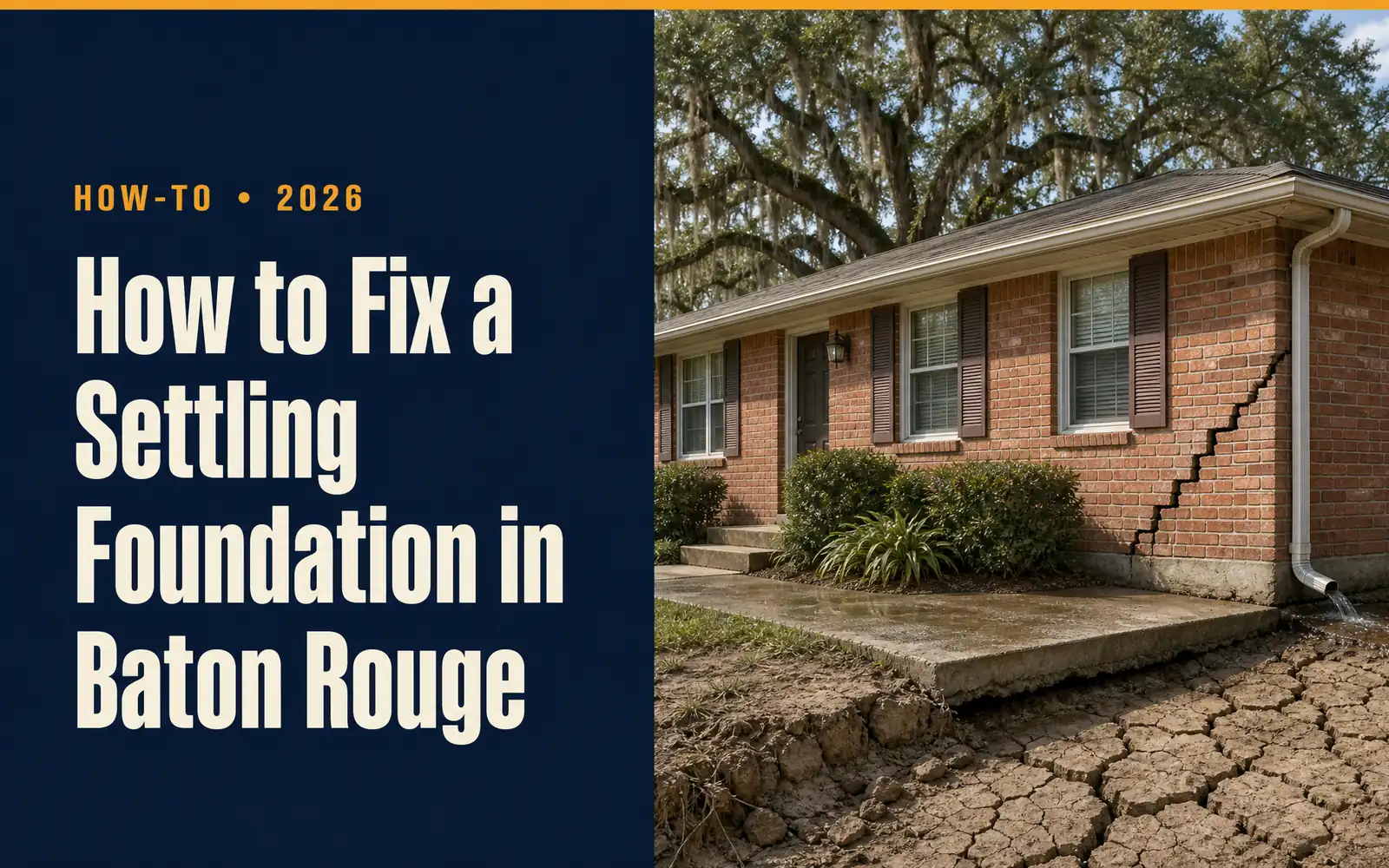
How to fix a settling foundation in Baton Rouge? Stop the water that is shrinking or softening the clay under one side, even out the soil moisture, measure the house through one wet-dry season, and put pilings only under the part that keeps dropping.
Key Takeaways
- Engineers' own repair guidelines say fixing drainage and moisture first, then monitoring, "may be a prudent approach" before or instead of structural repair — ASCE Texas Section, 2022
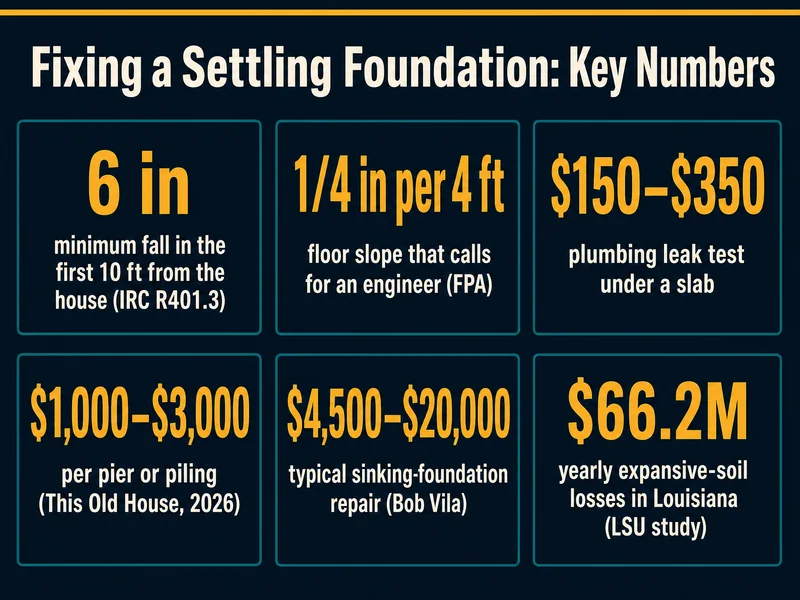
- The residential code wants the ground to fall at least 6 inches in the first 10 feet away from the house — IRC R401.3 via InterNACHI
- A slope of more than about 1/4 inch over 4 feet on a carpenter's level may mean unacceptable movement and is worth an engineer's look — Foundation Performance Association
- A plumbing leak test under a slab costs about $150 to $350, a fraction of a piling job — HD Foundation Repair
- Sinking-foundation repair runs about $4,500 to $20,000 nationally, with piers at $1,000 to $3,000 each — Bob Vila, This Old House, 2026
- Underpinning one side "will not improve the performance of the foundation in non-underpinned areas," so the water still has to be fixed — ASCE Texas Section
What does fixing a settling foundation actually mean?
Fixing a settling foundation means stopping the movement, not making the floor perfectly flat again. On Baton Rouge clay that usually takes two jobs: controlling the water that moves the soil, and, only if the house keeps dropping, supporting the low side on deeper ground.
Every house settles a little. Our guide to house settling vs foundation problems covers how to tell normal settling from movement that needs repair. This article starts where that one ends: you have measured, one side is low or getting lower, and you want to know what to do about it.
The reason the order matters is the soil. The USDA soil survey of East Baton Rouge Parish rates clays such as Sharkey as high shrink-swell and says much foundation damage here comes from soils shrinking and swelling as they dry and wet. A 2021 LSU-led study in Frontiers in Built Environment put Louisiana’s expansive-soil property losses at about $66.2 million a year. A settling foundation here is usually a water problem first and a structural problem second.
What do you need before you fix a settling foundation?
You need a baseline, a rainy day and a few basic tools. Most of this costs nothing.
- A way to measure level. A 4-foot carpenter’s level works for spot checks. A water level (clear tubing filled with water) or a rotating laser lets you compare points across the house.
- A crack log. A tape measure or crack card, a pencil and a phone camera. Date every reading.
- A floor plan sketch. Mark where you took each reading so you can come back to the same spot.
- Your water meter. It is the cheapest leak detector you own.
- Patience. Plan on watching the house through at least one wet-to-dry change before you spend money on pilings.
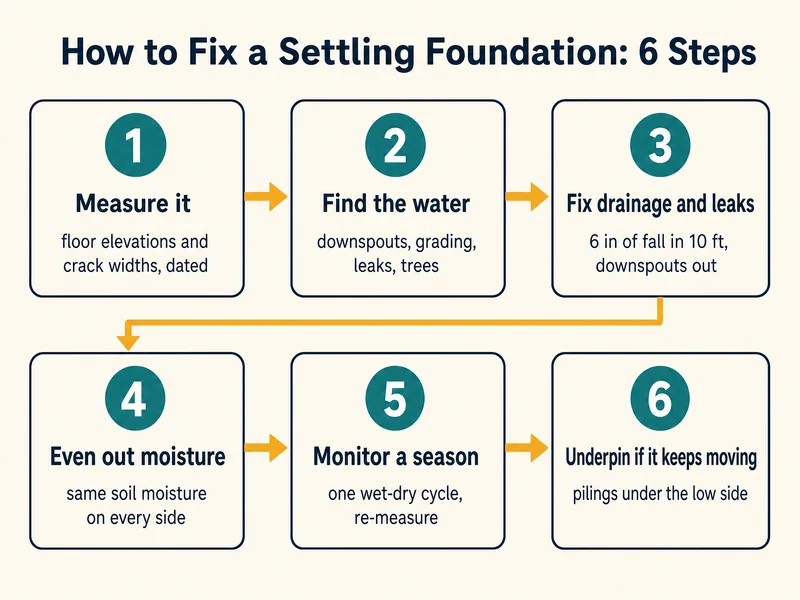
Step 1: How do you measure a settling foundation?
Measure it with numbers you can repeat, not with a feeling that the floor “seems worse.” Pick a reference point near the middle of the house, take readings at the corners and along the walls, and write them on your sketch with the date.
The Foundation Performance Association’s Homebuyers’ Guide for Foundation Evaluation says to spot-check floors with a four-foot carpenter’s level, and that more than 1/4 inch of slope over four feet “may be an indication of abnormal” movement worth a professional engineer’s look. Its companion guideline on measuring floor elevations adds a warning: a spirit level may be useful for door frames and countertops, “but should not be used to measure the Slope of the Foundation.” For that you want a device accurate to about 1/8 inch, which is why contractors and engineers use lasers and manometers.
For cracks, measure the width at the widest point and pencil-mark the ends. Our step-by-step guide to fixing foundation cracks shows how to log them. A free foundation inspection with laser-measured readings gives you the same baseline in one visit.
Step 2: How do you find what is making the foundation settle?
Find the water. In Baton Rouge, a settling corner almost always lines up with something that makes the clay under it wetter or drier than the clay under the rest of the house.
Walk the outside during a heavy rain and look for these, in this order:
- Downspouts that dump at the slab edge or into a flower bed against the house.
- Low spots where water ponds within 10 feet of the wall.
- Trees and large shrubs within reach of the foundation, which dry the clay out in summer. See tree roots and foundation damage.
- Plumbing leaks. Turn off every tap and watch the water meter. If it still moves, call a plumber. A hydrostatic test of the drain lines under a slab costs about $150 to $350, according to HD Foundation Repair.
- Fill pads. Many newer subdivision homes in Ascension and East Baton Rouge parishes sit on hauled-in fill that can keep consolidating for years. Our post tension slab guide explains why.
| What you find | What it does to the clay | First fix |
|---|---|---|
| Downspout dumping at the slab | Keeps one corner wet, then lets it dry hard | Extend it well past the beds, into a well-drained area |
| Ground sloping toward the house | Ponds water at the beam | Regrade to 6 inches of fall in the first 10 feet |
| Tree within reach of the slab | Shrinks the clay in summer and drought | Prune or add a root barrier; ask an arborist first |
| Leak under the slab | Softens or washes out the soil | Pressure test, then repair the line |
| New fill pad | Fill compresses over several years | Measure over time; pilings if it keeps dropping |
| Long drought | Clay shrinks away from the slab edge | Keep moisture even; don’t just pack dirt into the gap |
Step 3: How do you fix the drainage around a settling foundation?
Fix drainage by moving roof water and surface water away from the slab and keeping it away. This is the step most likely to stop a settling foundation on its own, and the one most homeowners can do themselves.
The International Residential Code’s drainage section, R401.3, requires that the ground fall at least 6 inches within the first 10 feet of the foundation, and that paving within 10 feet slope at least 2 percent away, as InterNACHI’s summary of the code puts it. The Texas Section of the American Society of Civil Engineers uses the same 5 percent figure in its repair guidelines (Version 3, adopted 2022), and adds that downspouts “should be extended well past the edge of the foundation, past the edge of abutting planting beds, and into well-drained areas.”
The same guidelines draw a line many installers miss: downspouts may run into solid pipe, but “downspouts and surface drains should not be connected to perforated pipe subsurface drainage systems.” A French drain is for groundwater, not roof water; our step-by-step on how to install a French drain in Baton Rouge clay shows how to keep the two apart, and French drain vs swale explains when an open grass channel is the better fix for surface water. Our foundation drainage service covers regrading, solid-pipe downspout lines and French drains, and the hurricane-season drainage checklist is a good walk-around list.
A Louisiana homeowner on TigerDroppings with sticking doors after heavy rain got the same advice from a poster in Head of Island: make sure water flows away from the house, not under it, before anything else. Another replier said leveling alone left new drywall cracks and suggested gutters if drainage was the cause.
Step 4: How do you keep soil moisture even around a settling foundation?
Keep the clay on every side of the house at about the same moisture, all year. Uneven moisture, not wet or dry soil as such, is what bends a slab.
The ASCE Texas guidelines put it plainly: “maintaining near uniform soil moisture conditions near all sides of the foundation may be beneficial,” and caution against excessive watering. In practice that means:
- In drought, water the bed along the foundation evenly. A Texas A&M AgriLife extension tip from Bexar County suggests a soaker hose between the foundation and the shrubs, run “at least four hours a day every two weeks in lieu of an inch of rainfall.” Adjust for Baton Rouge’s wetter climate and stop when it rains.
- Near trees, the guidelines say removing a tree “may stop shrinkage” but can cause heave if the tree predates the house, and that pruning “may be a prudent alternative to removal.” Talk to an arborist before cutting roots.
- Don’t pack dirt into the gap. In 2023, Fox 8 reported that Terrytown homeowner Ramona Synigal’s foundation was sinking again in the drought and she had half a load of dirt delivered, after doing a similar repair three years earlier. Fill restores grade; it does not lift a house.
Baton Rouge swings hard between the two. East Baton Rouge Parish went from no drought in early August 2026 to almost entirely in moderate drought by late September, as our El Niño rain and drought update explains. That swing is exactly when settling shows up.
Step 5: How long should you monitor a settling foundation?
Monitor it through at least one wet-to-dry change, re-measuring the same points every month or two. If the numbers stop changing after you fix the water, you may not need structural repair at all.
That is not a homeowner shortcut; it is in the engineers’ guidance. The ASCE Texas Section guidelines say: “Applying non-structural remedial measures and monitoring foundation performance prior to or in lieu of structural repairs may be a prudent approach.” The key is honest numbers. A reading that drops another 1/4 inch after the downspouts were fixed tells you the water was not the whole story.
Step 6: When does a settling foundation need pilings?
A settling foundation needs pilings when one area keeps dropping after the water is under control, or when the slope is already beyond what the house can live with. The fix is to carry that part of the house on deeper, more stable soil, below the clay that shrinks and swells.
On a slab, that usually means pressed concrete pilings or steel push piers driven under the perimeter beam on the low side, then a careful lift. Our pilings vs steel piers vs helical piers guide compares the options, and what a typical slab repair looks like walks through the job. On a raised house, the pier and beam repair equivalent is re-shimming, replacing failed piers and fixing rotted framing, with house leveling to bring the floor back.
Two cautions from the ASCE Texas guidelines are worth knowing before you sign anything. First, underpinning part of a house “will not improve the performance of the foundation in non-underpinned areas.” Second, “it is unlikely that elevation adjustments will result in a level foundation.” The guidelines also call for testing water and sewer lines for leaks after any lift.
| Method | Best for | Typical cost signal |
|---|---|---|
| Drainage and grading fixes | Settling caused by roof or surface water | Far below a piling job |
| Plumbing leak repair | Soil softened or washed out by a leak | Test about $150-$350, then the repair |
| Pressed concrete pilings / steel piers | A slab side that keeps dropping | About $1,000-$3,000 per pier (This Old House) |
| Mudjacking or foam under the slab | Filling voids, small lifts of flatwork | About $500-$1,300 (HomeAdvisor) |
| Pier-and-beam shimming and pier replacement | Raised houses with sagging floors | About $2,000 for shimming (forum-reported) up to full rebuilds |
Mudjacking a house slab rarely fixes settlement by itself, because it rests on the same clay. Our mudjacking vs polyurethane foam guide explains where it fits. On a raised house, a sag in one room is often the framing rather than the piers; our guide on how to fix sagging floors walks through that check.
What does it cost to fix a settling foundation in Baton Rouge?
A settling foundation costs anywhere from a few hundred dollars for drainage work to the tens of thousands for a full piling job. National guides put sinking-foundation repair at $4,500 to $20,000 (Bob Vila), and Louisiana contractor Abry Brothers puts most Louisiana projects at $5,000 to $25,000, plus $500 to $2,000 for a stamped engineer report and soil borings.
The biggest cost driver is how many pilings the job needs, which is why a written per-piling price matters. Our Baton Rouge foundation repair cost guide has local ranges, and the cost estimator gives a quick range for your house.
What have Gulf South homeowners learned fixing settling foundations?
The forum record shows three patterns: exterior-only work can be enough, partial work can move the problem, and dirt alone does not last.
In a 2025 TigerDroppings thread, a Jackson, Mississippi homeowner on Yazoo clay had a sinking slab corner repaired entirely from outside, with no digging inside. They were told to wait about six weeks before fixing interior cracks, and some cracks got worse after the lift. A reply suggested an engineer’s visit for about $400, and one poster said an engineer had once told them not to do any work because the readings were within limits.
On City-Data’s Houston forum, a homeowner described a “bowl effect”: the previous owner had piered only the perimeter, the middle kept sinking, and the 1,600 sq ft house then needed eight interior piers plus new perimeter piers. That is the ASCE warning about non-underpinned areas, in real life.
And the Terrytown case above shows the dirt-only fix coming back in the next drought. Put together, the lesson is the same as the steps: fix the water, measure, and if you pile, make sure the plan covers the area that is actually moving.
What I'd do: my take as a concrete and steel repair specialist
If my Baton Rouge house were settling, I would not call for pilings on day one. I'd spend a weekend on the cheap work: extend every downspout past the beds, fix the grade so it falls 6 inches in 10 feet, check the water meter for a leak, and get one proper set of floor elevations. Then I'd re-measure at the end of the next wet or dry spell.
If the low corner kept dropping after that, I'd stop waiting and support it properly, with an engineer's or contractor's plan that shows where every piling goes and why that area is the one moving. In industrial repair work, the rule is that you never repair a crack or a support without first removing what caused the damage, or you end up doing the repair twice. Foundations are no different. I'd also insist on a plumbing test after any lift, a written per-piling price, and a warranty that names the piled area, and I'd check the contractor's license and $500,000 liability certificate before signing. And I'd keep watering and draining evenly afterward, because the clay under the un-piled part of the house hasn't stopped moving.
What goes wrong when homeowners fix a settling foundation?
Most failed fixes skip a step. The common mistakes:
- Piling before fixing the water. The piled side stops moving; the rest keeps swinging.
- Partial repairs that move the problem. Perimeter-only work can leave a sinking middle, as the Houston “bowl effect” case shows.
- Chasing perfectly level. Lifts are limited by what the slab, plumbing and finishes can take. The ASCE guidelines say a level result is unlikely.
- Over-watering. Soaking the bed against the slab can heave it. Aim for even, not wet.
- Sealing cracks first. Patching before the movement stops hides your best evidence. Seal last.
- Skipping the plumbing test. A lift moves the slab the pipes run through, which is why the ASCE guidelines call for testing water and sewer lines afterward.
If you’re not sure which step you’re on, our guide on whether you need a structural engineer explains when an engineer’s report is worth it, and our slab foundation repair page covers how we approach a settling slab.
Is your foundation still settling?
Book a free foundation evaluation from Foundation Repair Baton Rouge. You get laser-measured readings, a straight answer on whether drainage alone can fix it, and a written per-piling price if it can't, backed by 20 years of industry experience.
Methodology. This how-to is built on primary and named sources: the ASCE Texas Section's Guidelines for the Evaluation and Repair of Residential Foundations, Version 3 (adopted 2022, read in full), IRC R401.3 as summarized by InterNACHI, two Foundation Performance Association guidelines, a Texas A&M AgriLife extension tip, the USDA East Baton Rouge Parish soil survey and the 2021 LSU-led expansive-soil study. Costs come from This Old House (2026), Bob Vila, HomeAdvisor, HD Foundation Repair and Louisiana contractor Abry Brothers; forum-reported prices are labelled as such. Homeowner experiences come from three forum threads (TigerDroppings 2016 and 2025, City-Data) and one Fox 8 news report, paraphrased with links; Reddit was not reachable from our research tools. Search demand comes from a DataForSEO pull on October 7, 2026: "fix settling foundation" has about 4,400 U.S. searches a month, and the Baton Rouge results are national directories, forums and basement-state contractors, with no Louisiana guide. No customer stories, job counts or reviews are used; the hero and infographics are AI-generated illustrations, not photos of real houses.